Dear Wisdom Academy family, Alhamdulillah, another school year has begun! The teachers have written summaries and provided their photographs to give you a glimpse into our wonderful school activities. Please take some time to read and enjoy!
Alhamdulillah! We thank the parents, families, and community for their continuing support and encouragement. If you have any questions, comments, or ideas, we would love to hear from you! Please leave your comments!
By Mrs. Malak Charara, Science and Electives Teacher:
At the beginning of their middle school science learning journey, Grade 6 students were introduced to what science is, the scientific method of inquiry and lab safety and tools. They explored the characteristics of living things, what they are made up of and how to use and handle a compound microscope. After that, students started investigating the different Domains and Kingdoms to understand the Diversity of life Allah (swt) has magnificently created.
Grade 8 students started their investigations this year with Planetary Science! They learned about the Earth’s tilt and rotation around its axis, the relationship between Earth and its moon and the Sun it revolves around leading to events like day/night, seasons, and solar and lunar eclipses. Students also spent some time learning more about our only natural satellite “The Moon!”, they studied about its origins, weather, effect on tides and types of craters. They also got the chance to look at astronomy from the perspective of our Holy Quran and infer how mesmerizing Allah’s creation is.
In their elective yearbook class, grade 8 students learned about photography basics, practiced taking pictures indoor and outdoor with respect to what they’ve learned. The were also introduced to the different types of coverage and brainstormed ideas that would be helpful to set the foundations of planning for great results Insha’Allah.
Grade 10 students were introduced this year to the AP Biology course, its general content, learning expectations, method of delivery and its exam. They launched the first unit by reviewing the foundations of the chemical basis of life, which is needed for mastery of future areas of focus. Students learned about the properties of water which play a vital role in the survival of individuals and biological systems. They also learned that living systems exist in a highly complex organization that requires input of energy and the exchange of macromolecules. In the second unit, they studied about the cell’s structural organelles and their functions and how it facilitated the transport of substances in and outside of itself, which of course is just a minor example of Allah’s Divine creation within ourselves!
Grade 6 students working on the lab experiment “Is anything alive in here?” where they had 5 unknown materials put in different liquid solutions and had to note their observations after 0 then 10 minutes and after 72 hours and infer whether they were living organisms.
By Mrs. Batool Kamar, Math and Electives Teacher:
Grade 6 students built on previous knowledge of order of operations that they learned in elementary, to evaluate more complex numerical expressions including exponents and nesting parentheses. Then they reviewed the concepts of factors and multiples of a number to learn the process of finding the least common multiple (LCM) and the greatest common factor (GCF) of two or more numbers. Students then examined the properties of multiplication and division, and built on the knowledge of distributive property to learn how to apply mental multiplication and mental division. They then moved on to reviewing operations on fractions including multiplication and division of fractions, where they visualized these operations in interactive class activities, and used them to solve real-world problems.
Grade 10 students identified the key features of the graphs of linear, quadratic, and absolute value functions, and saw the effects of transformations on the key features of their graphs. They also understood step functions and piecewise-defined functions and graphed them. They then moved on to learn about sequences, and to write the general rule for an arithmetic sequence both recursively and explicitly. Students then used graphs, tables, and technology to approximate solutions and solve equations and inequalities, and to solve a system of equations and inequalities in two or three variables. And finally students examined further quadratic functions in the vertex, standard, and factored forms. Students used these different forms to identify key features and find the zeros of quadratic functions, and used them to solve real-world problems.
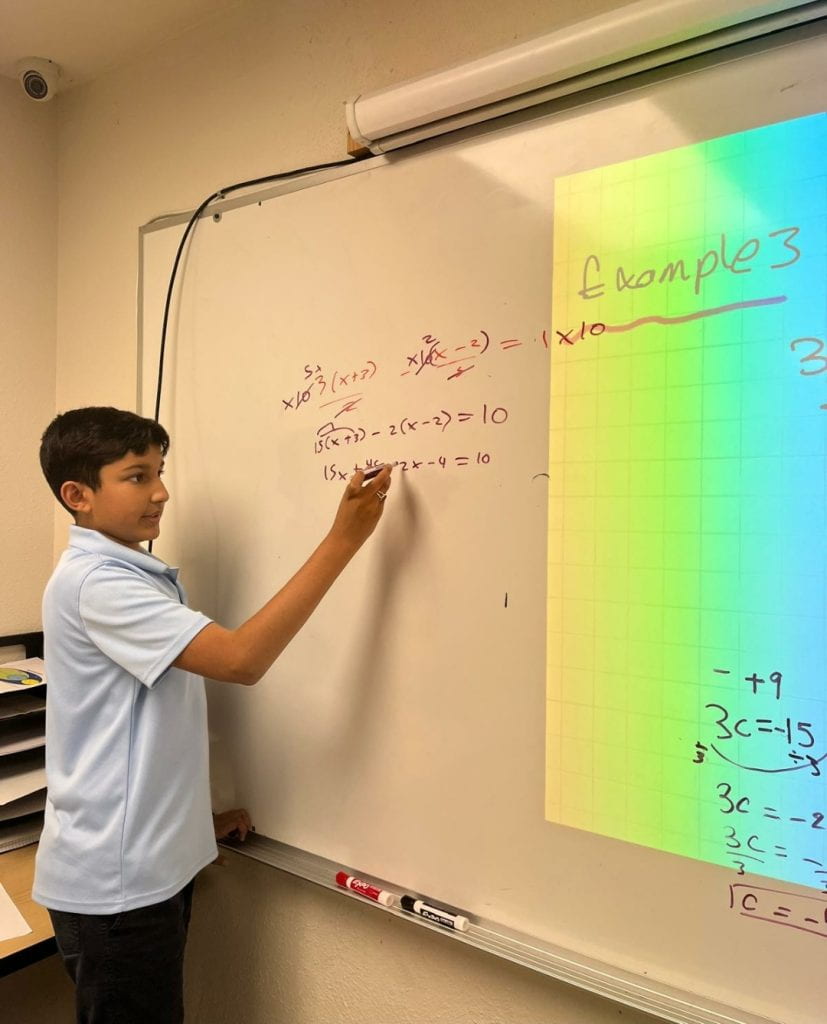
Grade 8 students started their school year by studying the laws of exponents, and the meaning of negative and fractional exponents. They used them to evaluate complex expressions by successively using these laws. Students explored scientific notation and significant figures of a number , and discovered that sometimes we use approximations to estimate the result in some real-world problems, rounded to a specific number of significant figures. Later, students moved on understanding linear equations in two variables, as they reviewed what does it mean to have an equation in two variables, how we can represent it by a line on the coordinate system, and what does each solution mean graphically. They extrapolated this knowledge to solve a system of two equations in two variables, by graphing both equations and look for the solution of the simultaneous equations. Students were able to observe graphically what does it mean for a system of equations to have one solution, no solution, or infinitely many solutions.
Grade 6 Life Skills Class: Our 6th graders started their Life Skills class by identifying the importance of effective communication skills in their lives , and the effects of miscommunication. Later they understood the significance of time management, where they learned various techniques to manage their time effectively and practiced these skills through activities. Students also explored the topic of stress management, and learned how to identify physical and emotional signs of stress, and learned some basic stress management techniques. We had Sr Zaineb Sabir as a guest speaker, a Child-Centered Play therapist, to discuss such an important topic with our students. Another important topic the students explored is understanding the difference between conflict and bullying, identifying strategies to manage a conflict, and recognizing how to prevent and respond to bullying. Br Aaron joined our 6th graders briefly to share some of his experience in this area. And finally, we were glad to have Coach Tatheer as a guest speaker, to teach the students the importance of a healthy life style and a proper diet.
By Br. Yusuf Ali, English, History, and Social Studies Teacher:
In social studies, the 6th graders are studying Early Hominins and the Rise of Civilization, the 8th graders are studying Early Civilizations of the World, and the 10th graders are studying the Colonial Era of U.S. History. All classes also did an introductory unit on human society and the Islamic perspective on history.
In English, both the 6th and 8th graders are reading Peace Be Upon Ibrahim, a collection of narrations about the life of Ibrahim Hadi. The 10th graders completed Narrative of the Life of Frederick Douglass, An American Slave. All classes also studied various topics in grammar, including the structure of phrases and sentences.
I pray you all are doing well, نا ءاش الله . The 2024-25 academic year at Wisdom Academy has begun rolling with great work and great minds, دمحلا – . Through the efforts of the children, the administration, the teachers, and especially you – our parents, we are off to a great start, . – دمحلا
The year began with many lessons of etiquettes to make for a well-running environment. Some students helped in providing these lessons to their peers. Creating teachers in all of us, keeps us connected to each other and also to the etiquettes of the environment.
Fifth-Year Boys Giving a Lesson on How to Cook Methodically
There are so many opportunities to show akhlaq in the environment. This is one of the great things about having a multi-age group. In between, there are always moments of friends helping friends. This draws children out in the service of others.
The Elementary students hosted the commemoration of the Arbaeen of Imam Husain (as) in held in a school-wide assembly. Everyone was eager to help fi sabeel Allah in both presenting and setting up.
Spotlight of the Month: Going Out
An important part of the Montessori Method is the concept of Going Out. It is the idea of having the children conceive, plan, organize, and carry out a field trip that they then follow-up on. The Going Out allows children to gain independence and responsibility as they venture out into the society outside of the elementary environment.
Going Outs can be based on research to meet with an expert to gather more information on their subject. It can also be going to get groceries for a cooking project. Recently, we had students take part in both types going outs. The process, simple in speak, is one that in practice provides many lessons.
Once they seek out an expert to provide more information on their research, children will contact the expert at school, in a well-rehearsed phone call and ask to set up a meeting with a professional in their needed field of inquiry.
In cooking and recipes, that calls for mathematics in tabulate quantities when a recipe is multiplied to provide for a class of 37. There is also the skill of carefully comparing costs online and making sure one stays within the budget of $10. The children must also provide the directions to their destination, letting the adult know which turns to take. If they provide a wrong turn (which is to be taken) then the consequence is perhaps lost time. They must be back at school at a reasonable time to join lunch or salaah or go home, depending on the time of their Going Out.
Once the preliminaries are taken care of, the next step is to go shopping or visit their expert. This is a great exploration in the development of any child. They begin by saying “Bismillah” and “Atawakkil ala Allah” as they fasten their seatbelts. They are orienting themselves to the streets and the store (if they are going shopping). They also become better communicators as they convey their message to store employees or related personnel or questioning the expert to have their needs addressed.
Upon their return, if they visited an expert, they would add additional data to their research. Similarly, if they went shopping, they would update the Going Out log and balance the class account to reflect money spent and change returned.
All this time, as they step out into society, an adult is their guardian, protecting them and ensuring their safety. Ms. Arsla ensures each child is safe and drives the children to their destination and back, but she does not provide any further aid to the Going Out. The children must seek out the expert and carry on the conversation or ask of their need. If the expert communicates with the adult, they are redirected to gear their attention towards the students.
Wisdom Academy’s Going-Out program dismantles the preconceived notion that children in Islamic schools will not grow to know how to communicate with the outside world. Rather, these programs go even further than the important task of communicating in this work. The students learn to read maps, count money, make savvy shopping decisions, and of course have another adventure. In the all of this, there is also the idea that each child is an ambassador to Islam, Wisdom, and especially themselves as a fine role model in society. We are blessed to have this program up and running, دمحلا – .
Going Out to Shop for Making Gummy Bears as an Addendum to Research
Going Out to Seek Expert Advice from Mr. John Goodboo on a Class Pet at the Dallas North Aquarium
This month we celebrated the citizens of our environment.
Happy birthday to Alihani Jasani and Haniya Hussain.
We also had the privilege of taking some lessons in embroidery from Ms. Batool Kamar, the Upper School math teacher. The children are embroidering their names as a start during Read Aloud.
دمحلا ‘ with the blessing of the beautiful weather, the Elementary has also been enjoying their Friday picnics.
As-salamu Alikum Dear Parents, I pray that you and your family are all well and healthy, Insha’Allah. Alhamdulillah, we have started our school year with a lot of excitement and hopes for a year that is filled with progress and achievement Insha’Allah. Our first six weeks were mostly a review and reinforcement of last year’s work. Here is a summary of your children’s Qur’an work during August and September, 2024.
Primary: Level One: (4 and 5 year old children who joined Quran program for the first time this year) Children Practiced the Taaweeth, the Basmalah, Surah Al Iqhlass الإخلاص & Duaa Al Elm دُعاء العلم . Level Two: (5 year old children) Reviewed some of last year’s Surahs and Duas (Surah Al Iqhlass الإخلاص, Al Kauthar الكوثر, Surah Al Asr العَصر, Surah Al Nass الناس& Surah Al Fatiha الفاتحة …etc) and Dua Al Elm , دُعاء العلم & Dua al Hasanah دُعَاء الحَسَنَة . In these two primary levels we focus on the correct articulation (Makharage) مَخارِج and the pronunciation of Arabic letters and words, and on the correct memorization of several small Surahs and Duas. (All Duas are from the Noble Qur’an).
Elementary: Group One & Two (level one Qur’an): Students learned and memorized all Arabic big letters (the disconnected form of Arabic letters), and the Arabic small letters (the connected form of Arabic letters), the three main vowels (Fatteha, Kasra, and Dhammah). They also reviewed some of last year’s Surahs and Duaas. Group Three (level two A Qur’an; students who finished learning the reading grammars last year) Students started reading the last 4 Juzah of the Noble Quran starting with Surah Qhaff ق then Surah Athariyatالذاريات (reading without repetition). Group Four (level two B Qur’an): Students began reading first half of the Noble Quran starting with Surah Al Fateha, then Surah Al Baqharah البَقَرة سورة (reading without repetition). They are also practicing reading Surah Al Jummah الجُمعَة سورة. Our main focus at level two (groups three & four) is on improving student’s recitation of the Noble Quran. Groups Five & Six (level three Qur’an): Students begin reading first half of the Noble Quran starting with Surah Al Fateha, then Surah Al Baqharah البَقَرة سورة (reading without repetition). And they practiced Surah Al Insan الإنْسَان which they prepared to recite at the school celebration of Prophet Mohammad (as)’s birthday. They also worked on writing, reading, and memorizing vocabulary lists: Nature 1 & 2 in Quran. Our focus at level 3 (groups five & six) is on reading, on Qur’an vocabulary memorization, and on writing; our goal is to help children learn the most efficient way of Arabic writing, to help them develop a sense of direction of their Arabic writing (which is the opposite of English writing’s direction), and develop a sense of the right size of Arabic written words.
Middle School: 6th grade: Students began reading the second half of the Noble Quran starting with Surah Al Kahff سورة الكهف, (reading without repetition). They reviewed Tajweed rules (Idghan, Iqhlab, and Qalqalah) in detail and applied them while reciting the Quran. Students also practiced reading and memorizing Surah Quraish سورة قريش , part one of Surah Al Waqhiah سورة الواقعة and the Dua after prayer #1 & #2 from the AL-Kisa book for the 6th grade. Students also reviewed general vocabulary lists: Nature 1 & 2 and Animals 1 & 2. 8th grade: Students began reading first half of the Noble Quran starting with Surah Al Fateha سورة الفاتحة, then Surah Al Baqharah البَقَرة سورة (reading without repetition). They reviewed Tajweed rules (Noon Sakehah and Tanween) in detail and applied them while reciting the Quran. Students also practiced reading and memorizing Surah Al Tariqhسورة الطارق, part one of Surah Al Furqhan سورة الفرقان and the Dua after prayer #1 & #2 from AL-Kisa book for the 8th grade. Students also reviewed general vocabulary lists: Nature 1 & 2, Animals 1 & 2, Food, Time 1, and Housing.
High School: 10th grade: Students reviewed last year’s Module One (Chapters 1 to 7) of the No Nonsense Arabic book. They also began reading the Noble Quran starting with Surah Al Fateha سورة الفاتحة , then Surah Al Baqharah البَقَرة سورة (reading without repetition. They reviewed Tajweed rules (Noon Sakehah and Tanween) in detail and applied them while reciting the Quran. They memorized part of Surah Al Hujurattسورة الحجرات Alhamdulillah. Students also reviewed many Arabic vocabulary lists: verbs, adjectives, nouns, and pronouns, as well as general lists of nouns: Nature 1 & 2 and Animals 1 & 2.
Dear Members of the Community, I, Mrs. Fizza Rizvi, Primary 2 guide, extend a warm welcome to all of you on behalf of Wisdom Academy. It gives me great pleasure to present our first Primary 2 Blog post for 2024-2025, offering you a glimpse into our classroom!
We are thrilled and gratified to have such delightful, cheerful, and enthusiastic students. It is a true honor to be their guide. Providing a safe environment where they can thrive and explore their abilities is a responsibility I deeply cherish. I sincerely hope to fulfill this duty with dignity and joy.
The return of our last year’s students was met with wholehearted enthusiasm, and to our surprise, our new students showed no signs of distress. Instead, they formed strong attachments with each other and were reluctant to leave at the end of the day. My wish is for this love and affection to endure, and, inshaAllah, for our environment to remain inviting and stimulating for all our students.
As we began the school year, we observed the “Ayyam -e- Aza,” commemorating and paying tribute to our Holy Prophet (PBUH) and his progeny, especially our Present Imam (a.j). Wisdom Academy’s Elementary students organized a Majlis in their classroom, graciously inviting us to participate. Although scheduling constraints prevented some students from attending, the gesture was deeply appreciated.
We are incredibly grateful to have entered the month of Rabi-ul-Awwal, as it marks the birth month of our Holy Prophet (pbuh&hf). Our children celebrated this significant occasion with tremendous excitement, reverence, and fervor. Their performances were truly remarkable and imparted valuable lessons to all of us. We extend our heartfelt thanks to every team member, including parents, the audience, and our beloved students, without whom this beautiful event would not have been possible. Thank you once again for your unwavering support.
In our classroom this month, we had the opportunity to hold the “Celebration of Life” event for two of our students. During this special occasion, we celebrated the children in a gracious and respectful manner. Both students generously shared snacks with their friends and made a meaningful contribution to the class by donating copies of their favorite books, which we will always hold in high regard.
Finally, you may be wondering why transitions are significant. We recognize the challenges many of you face while balancing work and supporting your children’s transitions. The importance of transitions within the daily routine lies in providing essential structure and security for children, enabling them to anticipate and adapt to changes throughout the day. It is crucial for the daily routine to remain flexible enough to accommodate the ever-changing needs and interests of the children. Successful transitions promote children’s emotional regulation, positive behaviors, and independence. At the heart of the transition process is the aim to support the emotional well-being of our students, particularly given that many of them, along with their parents, are experiencing separation for the first time. This may lead to separation anxiety, making it challenging for children to continue attending school. To address this, we have implemented a gradual transition, starting with one hour each day and gradually progressing to half days, to ensure a smooth adjustment period.
Thank you for your ongoing support and understanding.
Warm regards,
Mrs. Fizza Rizvi
Above Photos: Visiting Mrs. Mamdani’s Primary Class
Welcome to the 2024-25 school year at Montessori Wisdom Academy! We are excited to embark on this new journey of growth and learning with your children. We hope everyone had a restful and enjoyable summer break.
The beginning of the school year brings with it excitement, new routines, and opportunities to reconnect with old friends and make new ones. Each child adjusts to these changes in their own unique way, and it’s not uncommon to see jitters, anxieties, or even tears as they settle back into the school routine.
Building Independence and Classroom Community
Alhumdulillah! The first month has been filled with joy, new routines, and important transitions. Our younger students have been diligently working on developing independence with self-care tasks like dressing themselves, washing hands, and putting away their belongings—skills that are vital for both cognitive and social development.
The children have been exploring the materials on the shelves, receiving new lessons, and reviewing concepts from the previous year. This has allowed me to assess each child’s interests and development so I can introduce lessons that not only excite them but also help build their confidence and independence.
Meanwhile, our older students have embraced leadership roles by helping their younger peers adjust to the classroom environment. This interaction fosters new friendships and strengthens our sense of community. Lessons on grace and courtesy have also been introduced, teaching the children how to care for their classroom, respect their peers, and ease transitions between activities. A favorite new activity is walking on the line, which helps children move smoothly from one task to another.
Language and Math Development
In language, our younger students are exploring letter sounds using sandpaper letters, chalkboards, and tracing exercises. They are focusing on letters like ‘a’, ‘c’, ‘m’, ‘t’, and ‘s’. Older students are practicing building three- to four-letter words with the moveable alphabet, with a focus on lowercase cursive writing.
In math, younger students are working with sorting, shapes, patterns, and math manipulatives, while older children have started learning the decimal system with the Golden Bead material. They are also practicing skip counting using the long chains of squares and cubes.
Cultural Studies and Geography
We began our geography lessons by exploring the seven continents. The children are in the process of creating their own continent maps, which has sparked their curiosity about the world and different cultures. We also conducted a hands-on landform lesson outside, followed by a fun activity of making paper boats and racing them across the table.
Practical Life and Sensory Lessons
As part of our practical life and sensory activities, we’ve introduced various Montessori materials slowly. Activities like rolling and unrolling rugs, pink tower exercises, fabric matching, wet and dry pouring, and sandpaper globe exploration have engaged the children. They’ve also enjoyed tactile experiences like necklace lacing and refining their color discrimination with color tablets.
Our vegetable unit has also been a hit! Each week, a new fruit or vegetable is introduced to the class. The children learn facts about it, peel it, smell it, and even taste it. We began with corn, where the children eagerly peeled the husk layer by layer, smelled the corn, and then enjoyed tasting it. They also did a fun corn-themed craft afterward.
Islamic Studies: Love of Ahlul Bayt
In Islamic studies, we started the year with lessons from the Kisa Kids curriculum. The children are learning about the oneness of Allah (SWT) through discussions on “Who is Allah?” and the phrase “Laa Ilaaha Illallaah.” We encourage you to reinforce these teachings at home by pointing out Allah’s beautiful creations, such as trees and birds, during walks or daily conversations.
During Muharram and Safar, the children’s hearts were filled with love for Imam Hussain (A.S.). They participated in discussions about the events of Karbala and shared their understanding of the tragedy. We held a school-wide majlis to commemorate Arbaeen, and it was heartwarming to see the children’s pure expression of love for the Ahlul Bayt (A.S.).
We also celebrated the birth of the Holy Prophet Muhammad (SAW) with beautiful performances by the students, which were a reminder of the significance of faith in our daily lives.
Highlights of the Month:
Commemorating Arbaeen with a school-wide majlis.
Celebrating Eid-e-Zahra with our students.
Enjoying lunch outside with elementary students.
Celebrating the birth of the Holy Prophet Muhammad (SAW).
Looking Forward
As the year continues, we look forward to witnessing the academic, social, emotional, and spiritual growth of our students. Thank you for your continued support and involvement in your child’s education.
We pray that this year will be filled with blessings, excitement, and discovery for all of our students. We are truly grateful to Allah (SWT) for the opportunity to enhance our minds and hearts through knowledge and friendship.