We are thrilled to return and share the latest happenings in our classroom with everyone! It’s a wonderful time for us, especially because we have welcomed a new friend into our community. She has brought an incredible amount of positive energy, and we feel genuinely fortunate to have such a vibrant group of friends around us. Every moment spent together is something we truly cherish.
Let’s give you a glimpse into what we’ve been up to. For our first-year friends, we are busy engaging in a range of exciting lessons. They have been diving into wonderful activities such as spooning, pouring, and stringing. Along with these foundational activities, they are also practicing with sandpaper letters, which help them become familiar with the shapes of letters, and exploring the color box and two fantastic sensory experiences: the pink tower and the brown stairs. These exercises not only introduce them to important concepts but also lay the groundwork for their future learning.
Our second-year friends are equally busy! They are revisiting past lessons to solidify their understanding while also welcoming brand-new lessons. Some of the new skills they are exploring include reading and writing using movable alphabets, which allows them to play with the structures of words. They’re also learning to compose numbers, which involves understanding their relationships, and discovering the names of the tens. The excitement of having new friends in the group has sparked a lovely sense of camaraderie, and it’s heartening to see how they willingly assist their younger peers, fostering a warm and collaborative environment.
You might have noticed that I haven’t mentioned much about direct reading, writing, or numerical skills yet. This is intentional, as Montessori education emphasizes the importance of laying a solid foundation first. The initial phase focuses on preparing our students for reading, writing, and mathematics through practical life and sensorial activities. Each lesson they engage in has an indirect purpose, incorporating essential skills into their play. For example, when they work with the color box, they not only learn to identify and match colors, but they also connect these colors to their surroundings, enriching their environmental vocabulary. Activities such as spooning and pouring aim to develop fine motor skills and hand-eye coordination—crucial abilities that ultimately contribute to how they will hold a pencil later on.
Overall, our classroom is a hub of learning through joyful exploration, and we can’t wait to share more updates as we continue this incredible journey together!
In addition to our academic pursuits, we’ve had an abundance of fun, thrills, and excitement throughout the year. As many of you are already aware, one of the highlights of our week is the extraordinary story time we enjoy every Wednesday, led by the talented Shaikh Saadi. His engaging storytelling captivates our friends, who eagerly look forward to each session filled with adventure and imagination.
We also want to extend our heartfelt gratitude to all the parents who took the time to attend our lesson night. Your presence and support played a vital role in the evening’s success, and we truly appreciate your involvement. We hope you found the lessons delivered by our intelligent and enthusiastic new teachers both enjoyable and informative!
We are excited to return next month with even more captivating stories from our classroom, promising to make each session an enriching experience for everyone involved. Stay tuned for the upcoming adventures!
Dear Wisdom Academy family, Alhamdulillah, another school year has begun! The teachers have written summaries and provided their photographs to give you a glimpse into our wonderful school activities. Please take some time to read and enjoy!
Alhamdulillah! We thank the parents, families, and community for their continuing support and encouragement. If you have any questions, comments, or ideas, we would love to hear from you! Please leave your comments!
Dear Members of the Community, I, Mrs. Fizza Rizvi, Primary 2 guide, extend a warm welcome to all of you on behalf of Wisdom Academy. It gives me great pleasure to present our first Primary 2 Blog post for 2024-2025, offering you a glimpse into our classroom!
We are thrilled and gratified to have such delightful, cheerful, and enthusiastic students. It is a true honor to be their guide. Providing a safe environment where they can thrive and explore their abilities is a responsibility I deeply cherish. I sincerely hope to fulfill this duty with dignity and joy.
The return of our last year’s students was met with wholehearted enthusiasm, and to our surprise, our new students showed no signs of distress. Instead, they formed strong attachments with each other and were reluctant to leave at the end of the day. My wish is for this love and affection to endure, and, inshaAllah, for our environment to remain inviting and stimulating for all our students.
As we began the school year, we observed the “Ayyam -e- Aza,” commemorating and paying tribute to our Holy Prophet (PBUH) and his progeny, especially our Present Imam (a.j). Wisdom Academy’s Elementary students organized a Majlis in their classroom, graciously inviting us to participate. Although scheduling constraints prevented some students from attending, the gesture was deeply appreciated.
We are incredibly grateful to have entered the month of Rabi-ul-Awwal, as it marks the birth month of our Holy Prophet (pbuh&hf). Our children celebrated this significant occasion with tremendous excitement, reverence, and fervor. Their performances were truly remarkable and imparted valuable lessons to all of us. We extend our heartfelt thanks to every team member, including parents, the audience, and our beloved students, without whom this beautiful event would not have been possible. Thank you once again for your unwavering support.
In our classroom this month, we had the opportunity to hold the “Celebration of Life” event for two of our students. During this special occasion, we celebrated the children in a gracious and respectful manner. Both students generously shared snacks with their friends and made a meaningful contribution to the class by donating copies of their favorite books, which we will always hold in high regard.
Finally, you may be wondering why transitions are significant. We recognize the challenges many of you face while balancing work and supporting your children’s transitions. The importance of transitions within the daily routine lies in providing essential structure and security for children, enabling them to anticipate and adapt to changes throughout the day. It is crucial for the daily routine to remain flexible enough to accommodate the ever-changing needs and interests of the children. Successful transitions promote children’s emotional regulation, positive behaviors, and independence. At the heart of the transition process is the aim to support the emotional well-being of our students, particularly given that many of them, along with their parents, are experiencing separation for the first time. This may lead to separation anxiety, making it challenging for children to continue attending school. To address this, we have implemented a gradual transition, starting with one hour each day and gradually progressing to half days, to ensure a smooth adjustment period.
Thank you for your ongoing support and understanding.
Warm regards,
Mrs. Fizza Rizvi
Above Photos: Visiting Mrs. Mamdani’s Primary Class
Alhumdulillah, we have successfully completed another wonderful year at Wisdom Academy. As we reach the end of 2024, I would like to take a moment to reflect on the incredible journey we’ve shared together. From the very first day of school to our special events and enriching activities, this year has been filled with joy, learning, and growth.
As the academic year comes to a close, we thank Allah (SWT) and Ahlul Bayt (A.S.) for guiding and blessing us through another year. It has been a year brimming with laughter, curiosity, and remarkable growth.
Year at a Glance
Our year began with excitement as the children settled into their new environment, forming friendships and discovering the joy of learning. We celebrated numerous events and engaged in a variety of educational activities that have left lasting impressions on our young minds.
Highlights of the Year
Yuam e Hussain
Mother’s Day & Father’s Day
Maulud al Hujjah
Pumpkin Experiment
Eid Carnival
Planting with Parents
Hatching Chicks
Life Cycle of a Butterfly
The children were fascinated by the life cycle of a butterfly. They observed the transformation from caterpillar to chrysalis to butterfly, learning about nature’s wonders firsthand. This hands-on experience was both educational and enchanting, sparking curiosity and a love for nature.
Graduation: The culmination of our year was the graduation ceremony. It was a proud moment for all of us as we celebrated the achievements of our young graduates. As they start their second phase of development, we are excited to see them continue to thrive and succeed.
And Much More…
From art projects to science experiments, story time to outdoor play, every moment at Wisdom Academy has been filled with learning and joy. The children’s enthusiasm and curiosity have been a source of inspiration for all of us.
Year at a Glance Through Pictures
While words can capture the essence of our experiences, pictures tell the story more vividly. We have compiled a collection of photos that highlight these special moments, showcasing the smiles, creativity, and learning that have defined our year.
As we look back on this incredible year, I am filled with gratitude for the support of our parents, the dedication of our supportive staff, and the enthusiasm of our wonderful students. Thank you for being a part of the Wisdom Academy family. We look forward to another year of growth, learning, and joy.
May Allah’s blessing be upon each and every one of you during this break. We look forward to reuniting with you after the summer, as we continue this beautiful journey of learning and discovery together.
Here’s a glimpse into our last 2 months of the 2023-2024 school year!
Quran Studies News
By Mrs. Fadia Ali, Quran Studies Teacher
Alsalamu Alikum Dear Parents, I pray that you and your family are all well and having a great summer break Insha’Allah. Here is a summary of your children’s Qur’an work during April & May, 2024.
Primary: Level One: (4 years old and 5 years old children who joined the Quran program for the first time this year) Children reviewed all previous Surahs and Duaa’s which they learned throughout this year. Level Two: (5 years old children) Children practiced Surah Al Adiyatt العَادِيات and part one of Ayah Al Kursi الكُرسي أيَة. They also reviewed all previous Surahs and Duaa’s which they learned this year. We usually focus in these two primary levels on the correct (Makharyge) مَخارِج and pronunciation of Arabic letters and words, and on memorization of number of small Surahs and Duaa’s the correct way. (All Duaa’s are from the Noble Qur’an)
Elementary: Group One (level two Qur’an): Students continued reading Juza 30th of the Nobel Quran after they finished reading grammars (the Qaida). Group Two (level two Qur’an): Students continued reading the last two Juzas of the Nobel Quran (reading without repetition). They also continued practicing Surah Al Qyamah القِيامة سورة. Group Three (level two Qur’an): Students continued reading Surah Al Baqharah البَقَرة سورة (reading without repetition). They also continued practicing Surah Al Qyamah القِيامة سورة. Our main focus at level two (groups two and three) is on improving student’s recitation of the Noble Quran. Groups Four and Five (level three Qur’an): Students have finished reading Surah Al Baqharah البَقَرة (reading without repetition), while they are still practicing Surah Al Mulk المُلك سورة. Our focus at level 3 (groups four & five) is on reading, on Qur’an vocabulary memorization, and on writing; our goal is to help children learn the most efficient way of Arabic writing, and to help them develop a sense of direction of their Arabic writing (which is opposite of the direction of English writing), and develop a sense of the right size of the Arabic written words.
Middle School: 7th grade: Students reviewed Tajweed rules in more details and applied them while reciting part 1 to 7 of Surah Al Kahf الكَهف سورة (pages 1 to 14 of Surah Al Kahf), they also learned new Hadeeth of the Prophet and Ahlulbaiyt (as) (Hadeeth The best action & Hadeeth Maintenance of Continuous action), and Quran Quest; (Surah Al Adiyatt العَادِيات سورة & Surah Al Fil سورة الفيل). High School: 9th grade: Student learned Chapters 7 of the No nonsense Arabic book (The past and present passive voice verbs). They also finished reciting the Nobel Quran during the month of Ramadan and continued, after the month of Ramadan, their daily recitation of different Surahs while applying all learned Tajweed rules.
Elementary Class News
By Ms. Hind Sabir, Elementary Guide
Salaam Dearest Parents of the Elementary, As the doors of 2023-24 slammed shut as quickly as they flew open, the year began to ramp up rather than settle down these last couple of months. It was a bittersweet realization for much of our children who were saddened by the coming of the end – a true testament to the amazing work and spirit within Wisdom walls, ‘ . ال حمد Ultimately, the children began to take stock and reflect upon the people they want to become and how they want to return from summer. Summer is a great time to relax, travel, have fun, reconnect, and fine tune. Don’t underestimate the power within our children – they are amazing with their 90 billion neurons each! Reading, fiction and especially non-fiction, is always a great summer work that brings adventures and self-construction. While screens can bring the damage of deviations and inactivity evident to the body but more menacing and subversive to the brain. Limiting screen time is critical to a still-forming mind that needs to take a role in executive function when your child can make well-planned decisions that will further them as an individual.
Have a safe, healthy, and blessed summer full of wonders! See you in August!
By Mrs. Malak Charara, Science and Electives Teacher:
In Science, Grade 7 students learned more about plate boundaries and the “Plate Tectonics” theory which explains the science behind how some parts of our Earth’s lithosphere have been moving slowly over millions of years and shaping the continents we know and live on today. After that, we moved on to investigate the formation of another class of rocks known as “Metamorphic rocks” and how all three types of rocks can undergo metamorphism and change to one another in what is known as the “Rock Cycle”. Finally, we studied some geological phenomena such as earthquakes and volcanoes and concluded the semester by researching mesmerizing Geoscenarios that help remind us of Allah (swt)’s divine creation.
In Elective Nutrition, Grade 7 students learned about the essential micronutrients we need to survive, specifically vitamins. Students were introduced to the different categories, names and functions. We touched on some fun facts for selected vitamins as well and researched some disorders related to excess or deficient intake of some of the main vitamins like A, C and D.
In Biology, our Grade 9 student resumed her exploration in the unit of evolution as we tackled topics like evolutionary patterns and processes and finding order in Biodiversity to classify organisms based on various factors. The latter was a foundational lesson to introduce the last unit of study (Unit 6: The Diversity of Life). Each lesson in this unit explored a different group of microbes (viruses, prokaryotes, protists, and fungi), defined the group, the general structure, common reproductive strategies, and the roles of group members in the environment. We discussed real world examples of impacts to human health and how understanding disease-causing organisms helps us control them and prevent future epidemics. Next, we touched on the Plantae and Animalia Kingdoms in the same aspect and concluded the semester by investigating the complex systems and feedback methods that work together to maintain homeostasis in the human body. We learned about the structures and functions of the following systems: digestive, excretory, circulatory, lymphatic, immune, respiratory, nervous, skeletal, muscular, endocrine, and male and female reproductive systems.
As we come to an end to this fruitful academic year Alhamdulillah, I would like to thank our students and you as parents for all the time and effort you’ve put towards success and progress! Here are some photos from April and May 2024!
Grade 7 students presenting their three different Geoscenarios: Yellowstone Hotspots (by Alizar), Glaciers (by Sara) and Oil (by Mariam) as a final project to summarize and apply the Earth History lessons and concepts they’ve been investigating this semester:
Our Grade 7 students chopping some Fattoush vegetables for a taste test!
Grade 7 student preparing and decorating some dark chocolate covered strawberries as a healthy treat:
Grade 7 students sharing their presentations on vitamin D deficiency disorders in children and adolescence, their symptoms, and ways to include more vitamin D rich food into their daily intake to prevent such disorders:
Grade 7 students sharing their presentations on “Kwashiorkor” a protein deficiency disorder, it’s symptoms and how to include more protein in their diets to meet the Recommended Daily Allowance (RDA) and prevent establishing this disorder:
Our Grade 9 student enjoying some break time with the elementary chicks!
Our Upper School students enjoyed celebrating Eid A-Fitr with their annual “Secret Eid” tradition, Alhamdulillah — there were lots of gifts and joyful moments with their peers and teachers:
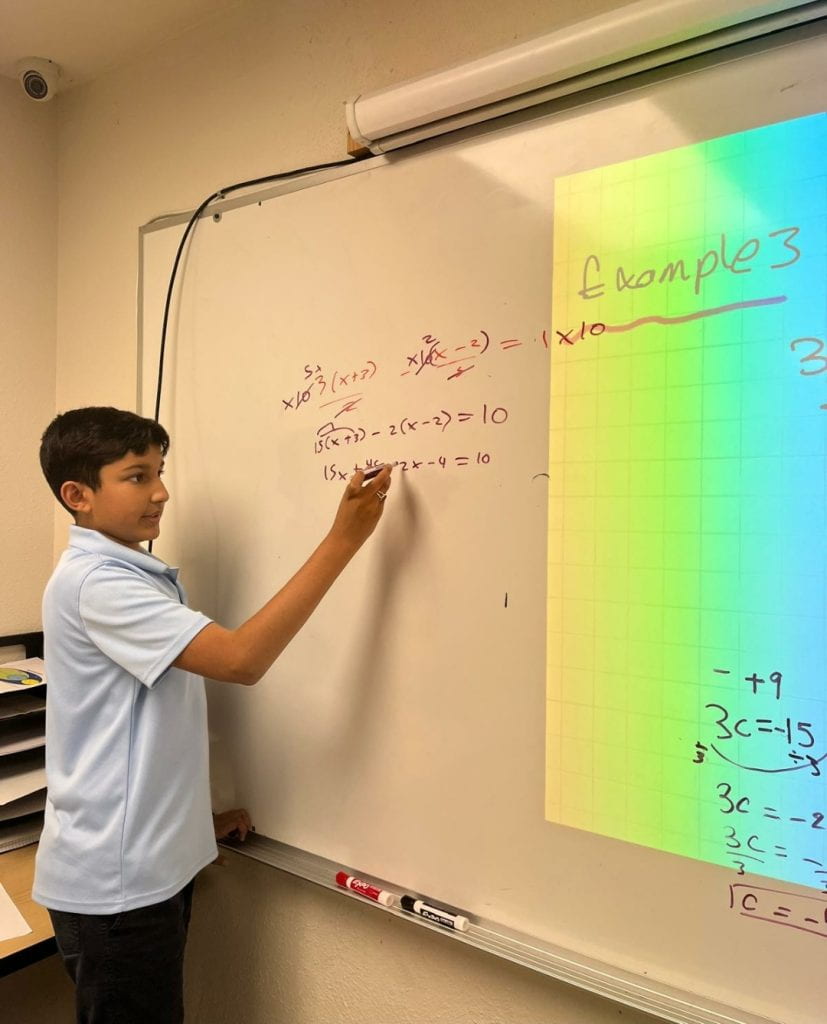
In Mathematics, grade 7 students were provided an overview of data-collection methods, and the process of organizing and presenting data, they learned how to draw and analyze dot plots of a data set. They built on their previous understanding of the mean and median as measures of center, to learn about the mean absolute deviation (MAD) as measure of variability for numerical data. They used this knowledge to implement a survey in elementary class about the number of sports liked by each student, displayed the data set on a dot plot, analyzed and understood the results. Furthermore, 7 graders started establishing a knowledge in probability by first understanding sets and sample spaces and their notations. They investigated probabilities of compound events and found these probabilities using possibility diagrams and tree diagrams. They learned about mutually exclusive events, independent events, and dependent events and the difference in finding their probabilities.
In Geometry, grade 9 students began with an examination of arc length, sector area, and segment area, and an introduction to radians as a unit of angle measure. Students then examined properties of tangents, chords, inscribed angles, and segments lengths. They then moved on to studying cross sections, and determining the 3D figure formed by rotating a 2D figure, and applied the volume formulas for prisms, cylinders, pyramids, cones, and spheres to solve problems. Finally they extended their previous knowledge of ratios and basic probability to the probability of multiple events, combinatorics, probability distributions, expected value, and used them to make decisions.
Grade 7 students presenting the data analysis of the survey they made in elementary class.
Grade 7 students trying to understand why the sum of seven when rolling two dice is the most probable outcome, using a possibility diagram and probability calculation.Grade 9 student proving the relationship between the volume of a cone and a cylinder of the same heights , and a pyramid and a triangular prism of the same heights in a class activity.
By Br. Yusuf Ali, English, History, and Social Studies Teacher:
9th Grade Social Studies completed research into the WWI Occupation of Palestine. 7th Grade Social Studies ended the Unit on the European Renaissance. English Studies included preparation for the SAT 10 Exam.
Inshaa’Allah
Alhamdulillah! We thank the parents, families, and community for their continuing support and encouragement. If you have any questions, comments, or ideas, we would love to hear from you! Please leave your comments!
First and foremost I want to congratulate you all for the blessed month of Ramadan and pray for everyone’s health and prosperity. May Allah bless the whole entire ummah with His endless blessings inshAllah. What a happening month March was! Be it the Wiladat of our Present Imam (a.j), co-curricular activities, or the start of month of Ramadan — it definitely felt like everything happened in the month of March! Let’s check the details of the events.
Highlights:
Maulud -ul- Hujjah a.j What an incredible event it was. I’d like to pay my gratitude to all of you for making this event a success. It was indeed one of the best school events, and it could not be this memorable and magnificent without your help and support. A huge and warm thanks to all the volunteers who helped us in any way. Our children worked so hard and showcased a beautiful performance for our audience. It wasn’t easy for our young friends to do this phenomenal performance, but again with all the support from our parents they did it.
Planting with Parents The next event in line was Planting with Parents. Since the start of the day everyone was very excited to plant with their parents. I thank and appreciate you all for taking out time and managing to come and be with your children. As our plants are now growing, so too is the excitement of our children to see the fruits of their plants!
Storytime with Syed Razavi Storytime is one of our children’s favorite parts of the week. We wait the entire week for this special activity. Storytime is not just an ordinary story but an indirect spiritual development. This month we were honored by Syed Razavi for our story time. He read us a beautiful story with a beautiful lesson behind it.
School Wide Iftar event As we welcomed the holy and blessed month of Ramadan. There could not be anything better but to open our fast with our dearest Wisdom Family. It was very wonderfully organized — all thanks to our volunteers and families who attended and made it an exciting event. It was a pure joy to see the excitement for the Kahoot. Congratulations to all the winners.
Now let’s talk about our classroom:
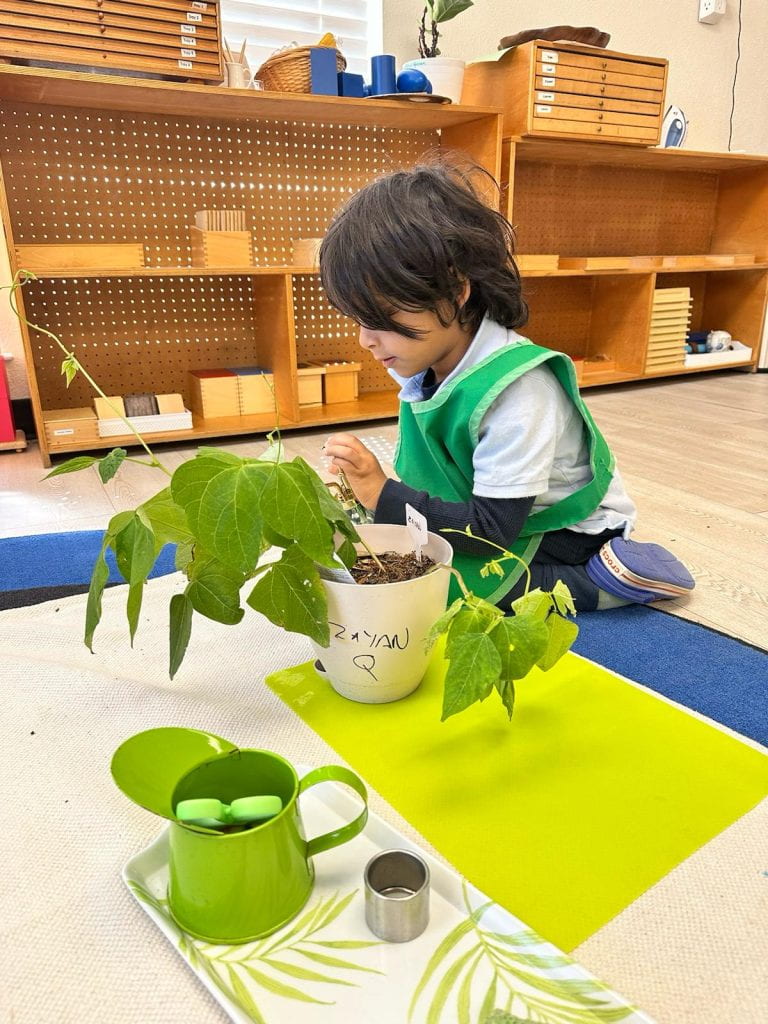
Practical Life: In our classroom we see the emergence of the will when the child makes a deliberate act. What are these acts of will that we see in the child? Each time the child chooses from a number of objects those that he prefers to work with that is an act of the will. It has been observed that young children are happiest when they are engaged in real-life, ordinary activities. They enjoy wiping down tables, sweeping floors or watering the plants or as simple as folding the clothes. We encourage our children to be the part of house chores at home so they have the opportunity and sense of being the important part of the community.
Language: You might be familiar with the old English saying, “Where there is a will, there is a way.” It implies that if you have a steadfast belief to achieve something, you will surely find a way to make it happen. This implies that when we are wilful about doing something, we are impulsive and determined to put the best of our efforts into the respective task. But on the contrary, if we impose our will on children, we are trying to make them do things they don’t desire to do. And this might lead them to protest and refuse to cooperate. The trivial habit of choosing a material from the available options enhances their will power. Hence, their will strengthens with every use. Every movement encourages the control of the body through the exertion of the mind; the will is at work in the smallest and largest ways. So when the child picks up the lesson with their own will they take interest in it. It may be movable alphabets to vocabulary cards to metal inset. And we can we when they pick it up with will or when they just pick it because that’s the first work in sight.
Math: The Montessori math materials provide years of hands-on learning for the Montessori child. It has a wonderful process of working with materials, from concrete forms to the more abstract. Using the Montessori Maths method, children are first encouraged to physically hold Number Rods. Children learn to organize numbers in their heads, understand how much space objects take up, and what numbers mean in “the real world” sense.
Conclusion: Will is also developed through order in a child’s life. Order supplements a better understanding of the surroundings. The more unfailing the routines and the rules are, the more adaptable they become for a child. In this way, they can easily and naturally be bequeathed in a child’s routine and further help to enhance their overall personality. Working in order will bring familiarity, ease, and comfort. And living within limits, according to guidelines and rules will bring self-discipline. Therefore, this way they can mold themselves into their better selves.
Post note: It is strongly recommended to please avoid high sugar content in breakfast such as donuts, entire glasses of juice, chocolate sandwiches, etc. Breakfast is an area we focus on, because it can lead to the sugar rollercoaster. Too much sugar at breakfast time ends up putting kids on a energy-high-and-crash cycle that goes on all day. Just like adults, they need more stable sources of energy that will keep their blood glucose levels stabilized. This helps with learning, concentration, and mood.
MARCH 2024 PRIMARY 2 PHOTO GALLERY
Story Time with Syed RazaviPlanting with ParentsPractical LifeMath
I would like to extend my heartfelt congratulations to you and your entire family for this blessed month of Sha’aban for the auspicious event of birth of not only our Imam of the time “Imam -e- Zaman (a.j)” but also, Imam Hussain (a.s), Hazrat Abbas (a.s) and Imam Sajjad (a.s). May Allah bless you all in this wonderful month, inshAllah.
During the month of February, we were also humbled to host and honor our Dads by celebrating Fathers Day on the birthday of our first Imam, Imam Ali ibne Abutalib (a.s). We had a beautiful event of breakfast with fathers to show our love and gratitude to them. We truly enjoyed and appreciated the event. A big shout out to all the fathers for being amazing dads! May Allah bless you all.
As a part of story time routine by our very own Shaikh Al-Saadi, we also get honored by different Shaikhs, Syeds, and Ustadahs. This month we were honored to welcome Shaikh Kazim Khoja. Our children loved the story, and leaned a lot from it.
Now some news from our classroom: we tend to focus on the learning abilities of our children by focusing on and practicing a routine. From the time they wake up in the morning and start their daily routine, to the end of the day– when they follow a routine it allows them to practice self discipline. It is a valuable repetition, so every time they do the same thing it may look like they are just repeating, but that process boosts their self esteem and also decreases the degree of difficulty.
Practical Life
Repetition of work will allow the children to practice, master, and retain the material. Daily repetition will give much needed practice and reinforcement. Some children are such careful observers while other children need more repetition and hands-on practice before they master a particular concept. It guides the child on how the repetition of activities can help them in day to day activities. Practical life activities revolve around strengthening the Fine Motor skills (pincer grip, pencil grip, and wrist movements) for young children. Most of the materials to conduct these activities are readily available at home. For example: loading and unloading of the dishwasher, folding clothes, dusting, and watering plants.
Sensorial Activities:
In sensorial lessons, repetition refines the five senses, encourages focus, breeds independence, and develops confidence in our work and ourselves.
Language:
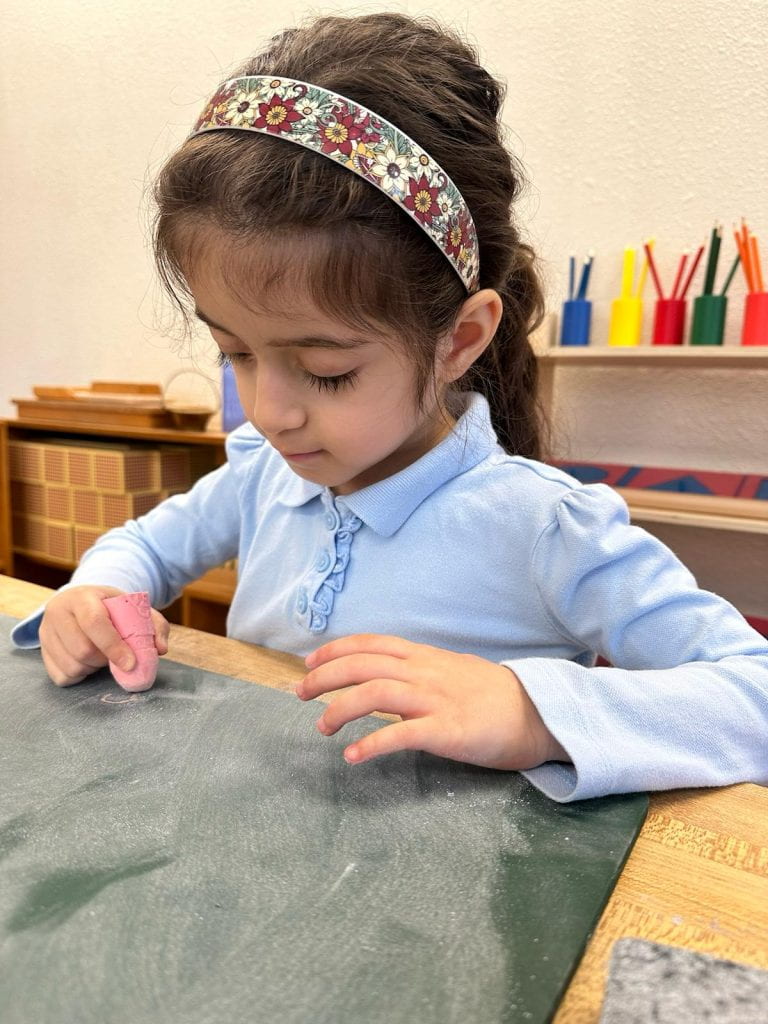
We follow our routine of daily writing (tracing) our names to help master in letter formation. We try to make it as fun as possible by using different colored markers and using an eraser. We enforce the sounds by practicing and repeating the same sound in many ways such as writing in the air, writing on the chalkboard, sand tray, sound book, sandpaper letters, and other ways. And the result has just been amazing. Initially it was a struggle to think of a thing that starts with a particular sound, but now we hear not just 1 or 2, but many things starting with the sound. Repetition is important– but so is consistency. The consistency comes daily until they master in achieving the right sound and recognition. CONSISTENT and encouraging REPETITION can create big benefits to the children.
Math:
In Montessori, children learn math in three different stages: sensorial, concrete, and abstract. A child’s mind is mathematical and based on the order of perceptual awareness found in the development of the senses. In addition, the Montessori materials, which are multi-sensory learning tools, teach children how to problem solve and self-correct through repetition and practice. This sustained period of repetitive activity encourages children to develop the concentration and self-discipline required for more advanced work. The acquisition of mathematical principles is seen as developing logically from concrete to abstract, and from simple to complex.
As we have entered in 2024, I pray for the health and prosperity of all our families.
The new year brought us so much maturity, strength, and confidence. Our bond with our friends is getting stronger with each passing day. As we are moving forward we are discovering new areas of our classroom. After working with Practical Life, Sensorial, and Language, now we have started Math exercises.
In Montessori, Math is introduced through shapes, touch and feel. So when we say Math, it’s not only about numbers, it’s sensorial and language as well. For Example: we start Math exercises with Number Rods, they are red and blue. When we start we touch it and say the number. It goes from 1 to 10. It helps the child to understand the linear progression of numbers, it helps the child with visual sense as well. It also guides the child into the discovery of new concepts in number, measurement and space and the consolidation of more familiar ones through the use of Montessori designed concrete material.
Though we love doing the Math exercises but at the same time we are so much attracted towards the other areas of the classroom as well. As we are moving along we are unfolding the more complex lessons. Each material in the classroom has many lessons which increases the degree of difficulty and keeps challenging the child.
In practical life, from pouring and spooning now we are folding the cloth and preparing the snack. From grinding 1 spoon of coffee to 3 spoons of coffee, from getting scared of scissors to cutting the paper confidently.
We can not tell the depth of language as it is everywhere- but the good news is: now instead of listening to “I want to do this,” I hear “I want to do the metal inset” — and it is a big accomplishment !
For Sensorial learning, after exploring most of the material, we still have a lot of excitement. How in the beginning we would only build a pink tower, but now we put all the cubes all around the classroom and we use our visual sense and guess which cube will be the next to make the whole tower. We used to play a lot of distance games and bring me games. Now when we do Geometry Cabinet — we match the shapes and we say “Teacher, this is a pentagon.”
Therefore, you might not see them reading or writing or saying numbers in sequence, but they are moving forward in a very beautiful way.
Let’s wrap this up but not to forget and appreciate how wonderful and lovely it was to have all the mothers to have breakfast with us. It was such a beautiful day. May Allah bless our Mothers. Aameen!
Last but not least, this month we had Sister Fatemah Meghji on our campus and we truly enjoyed our story time with her.
Can not wait to see what next month will bring us!
And just in the blink of an eye, here we are at the end of the first semester! We are truly thankful to Almighty Allah for the success of this semester. It was truly an amazing experience to meet all the parents and discuss the remarkable performance of our deserving students.
As we are unfolding every layer of our journey, not only are our children learning and experiencing new things, they are also teaching us many important lessons, and “observation” is one of them.
In our classroom, along with Practical Life lessons and Sensorial lessons, we have now started to dig more deeply into language, math, and geography.
In talking about language, i.e., communication, it allows the child to express her needs and ideas to others. Through language we are able to cooperate, collaborate, receive knowledge, and pass knowledge to others. Children go through a series of stages to acquire language. Montessori education provides a language-rich environment that helps children develop strong language skills. This includes both spoken and written language. For the enrichment of vocabulary we have tons of material all around us, it does not need to be only the material on the shelf — because everything around us has a name, and it is an addition to the child’s vocabulary bank.
For the second part of language, which is writing, we do not start writing alphabets right away. We have so many lessons which help indirectly in the development of writing skills. For example, we have metal inset lessons: though it may only look like tracing the shapes with different colored pencils — indirectly, it is motivating the child and helping his small hands for the writing strokes. Again, every lesson has an indirect teaching strategy.
As we are going deeper into language and we are learning new names around us, we are also learning our numbers. You may still hear them counting in an unordered sequence, but it’s just a new world for them — they are still learning the relation between recognizing numbers and the quantity.
With the help of Language and Math, we have started doing some big map work. They are over the moon to count the 7 continents and their names. And it is a very joyful moment to see when they find Antarctica on the globe because it is on the bottom of it or when they realize that Asia is the biggest continent and you hear the scream “Teacher look I found the biggest continent” or “You know what? My grandma lives in Asia” or “Australia, I went there with my Baba and we saw kangaroo.”
There are many more beautiful moments which we get to share. I really feel overwhelmed to be a part of their most important journey.
Last but not least, we had a beautiful “celebration of life” event for our friends. And we are looking forward to celebrating more inshAllah! And not to forget — enjoy your winter break with your family as we enjoyed time with our friends on the last day before break by having a pizza party!
The month of October is considered a “spooky” one, but not for our class– it was beautiful instead! As we are moving forward, nothing could describe the beauty of seeing children growing everyday. They may seem the same everyday but, surely they grow everyday as well! They may have started putting on their own shoes, which is a great accomplishment! You may notice them putting on their own jackets, which may not seem like much, but to the child it is a great achievement! It makes me joyful when I hear “look teacher, I did it myself!”
We are still practicing our Practical Life lessons, but we have also started doing a lot of Sensorial lessons. Many of our parents may be new to the Montessori method, and may not be aware of all these areas in a Montessori classroom such as Practical Life and Sensorial. Parents may ask: What is this? Why is it important for my child?
To explain, Sensorial activities play a crucial role in the development of the whole child. Children learn to perceive, interact, and experience the world around them and get prepared for success in higher education, life, and well-being. A Montessori classroom is designed meticulously to emphasize all five senses to introduce and develop everything that can be perceived. It helps prepare the children’s mathematical minds and encourages early language skills. Sensory activities introduce complex, abstract concepts to children tangibly and experientially. So, this approach sets the base for all future academic pursuits and provides an incredible educational experience. It is a learning that children will carry through their lives. The sooner children are exposed to different sensory activities, the better they will observe, understand, and process the information. The best example of this is when we start doing a knob cylinder with one block but gradually we add blocks and reach to the point where we do all four together.
While we are busy doing a lot of activities we also try to incorporate Islamic Studies in our daily routine. As you know we start our day with “Dua-e- Marifat” and now all our friends have started reading along. We are now learning names of our Imams and about our Holy Prophet (s.a.w.w). As we celebrated the most auspicious day of his birth. Last but not least, we had a visit from the Fire Department and our friends were able to see the fire truck in person and were able to get inside the truck– how interesting!
With this we will wrap and come back next month with more news next month, inshaAllah.
As we have completed our first month of being in the school, I would love to share some class news with you. This is also our classroom’s first blog post. How exciting!
We start our day with Dua-e-Marifat and rug time. During rug time we greet each other and talk about weather and things happening in life. After rug time we start choosing our work.
This is just the beginning of our Montessori journey. We are mainly focusing on practical life lessons. You might think what is Practical Life? Practical Life in Montessori is purposeful activity, develops motor control and coordination, and increases independence, concentration, and a sense of responsibility. The exercises in practical life cover two main areas of development: (1) care of self, and (2) care of the environment. For example: The activities can start with something as simple as pulling pants up or washing hands and can get as complicated as baking a dessert (don’t worry– we do not bake anything in our room!).
These skills, when taught early in life, allow children to believe in themselves as well as develop the self-discipline needed for success throughout their lives.
The Practical Life lesson not only develops a sense of responsibility, but it is also the indirect learning for our journey. For instance: we do spooning, this not only develops hand and eye coordination but also prepares children for pencil grip. Similarly, if we are doing knob cylinders, their purpose is to support visual discrimination skills. Additionally, the Knobbed Cylinders include work with language development, tactile sense, and even pre-writing skills.
We not only do our Practical Life or Sensorial Activities– whatever we do in our classroom involves vocabulary. As when a child starts school they have limited vocabulary. Therefore, we start with vocabulary cards, and start learning names of different things for example: fruits, transportation, vegetables, animals, things around the house, etc.
In addition, the highlight of our classroom day is when we have story time with Shaikh Saadi, 3 times a week. He focuses on the stories with an ethical lesson. Our children love story time!
Last but not least, we, Alhumdulillah, had a very beautiful event of Yawm-e-Hussain (a.s.)! It could not be done without our children’s hard work and dedication and of course– the parents’ support. Please accept my gratitude, I truly appreciate all the support!