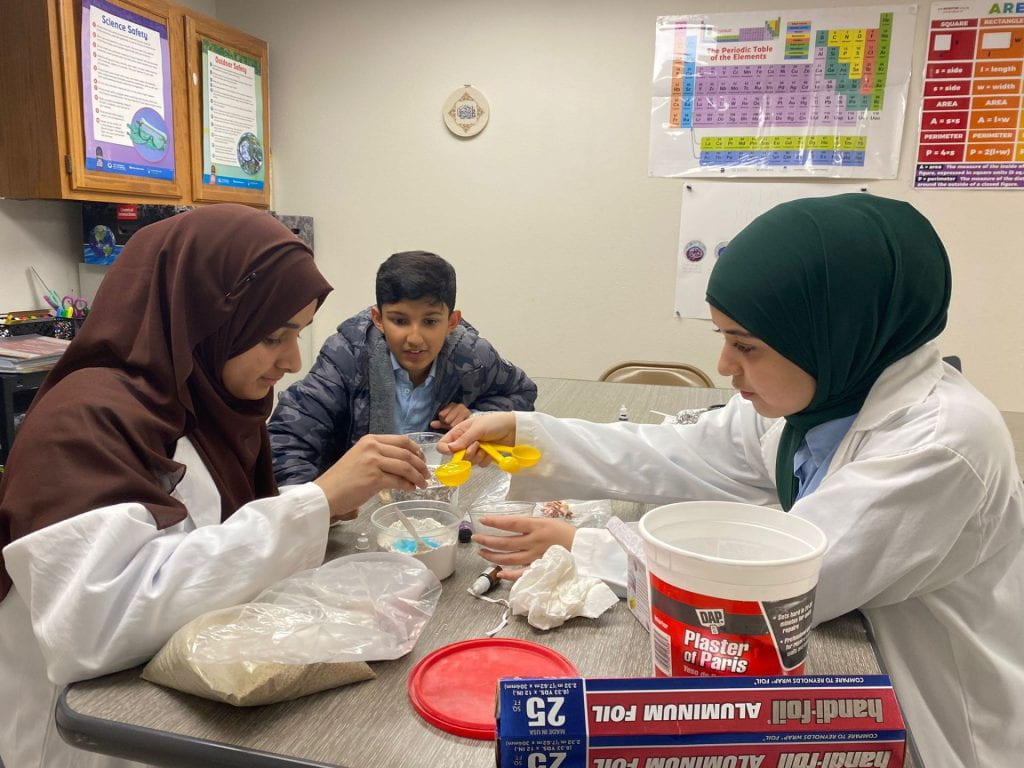
Grade 6 Life Skills Class: Our 6th graders were eager to learn more about volunteering in their community from our guest speaker Sr Malahat Kizilbash, representative of Who is Hussain in Dallas. They discussed what does it mean to be a part of a community and to give back, and how does it affect us as individuals and as a community. Then they learned about environmental issues to understand their impact and each group presented ways to make positive changes in their daily lives considering one of the issues. Later they learned key safety measures to practice at home, including but not limited to fire safety, and first aid basics.
Life skills guest speaker: Sr Malahat KizilbashStudents exploring the basics of first aid.6th graders presenting their thoughts about environmental issues.
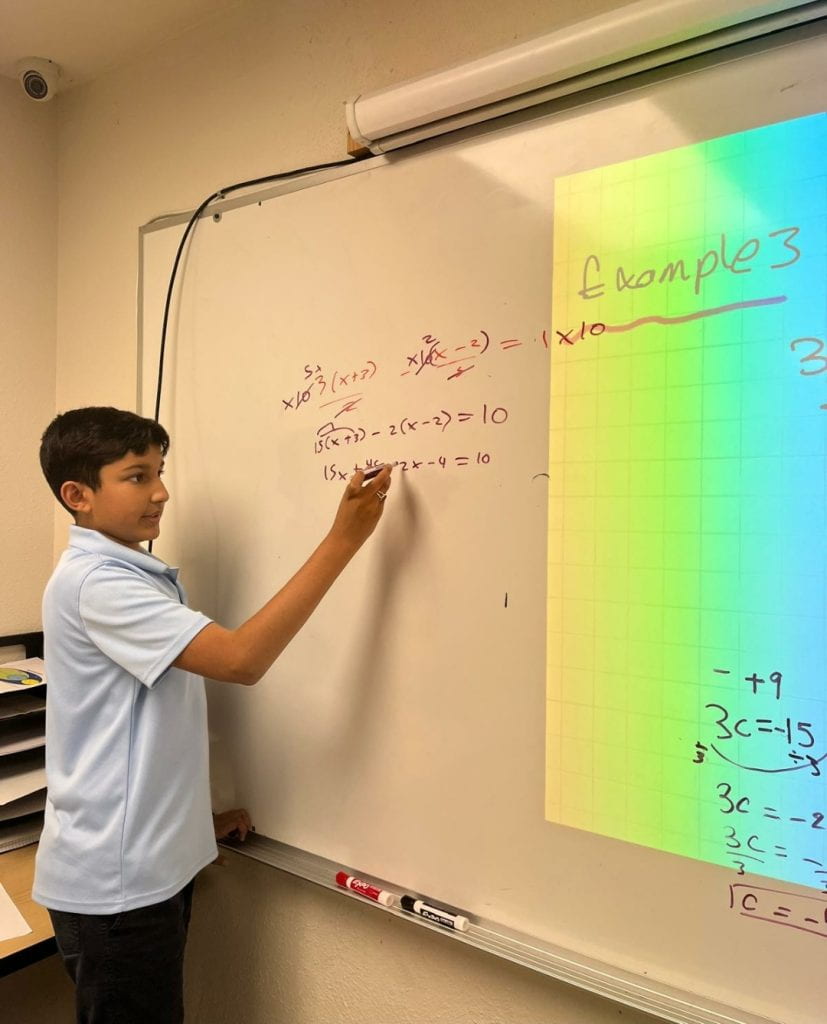
• Grade 6 students started by examining decimals, they recalled how to add, subtract, and multiply decimals, and then learned how to divide decimals as well. They explored how to write fractions as decimals as vice versa , rounding their answers for non-terminating decimals. Students then learned more about units, where they applied their understanding of decimals to convert metric measurement units. Students reviewed and extended their understanding to more complex calculations and applied them to solve multi-step word problems, by specifying the given , looking for keywords, determining the unknown, and the steps to finding it. Students are currently extending their understanding of real numbers by learning and positive and negative numbers.
Grade 6 students doing math classwork.
• Grade 8 students learned how to solve simultaneous linear equations in two variables algebraically, using both elimination and substitution methods, and they were provided some application problems to help them improve their problem-solving skills. Students recalled their previous knowledge of the distributive law of multiplication to multiply two or more algebraic expressions. They recognized how to spot algebraic expressions which can be expressed as the expanded form of the three special products and factorize them accordingly. Then they examined factorizing quadratic expressions that are not of the form of the three special products in both cases where the leading coefficients is 1 or different that one. Building on what they learned, students were able to solve quadratic equations by factorization using the Zero Product Property, and check if their solutions do satisfy the equation in hand.
Grade 8 students visualizing algebraic manipulation and expansion using algebra tiles.
• Grade 10 students continued learning about quadratic functions where they solved quadratic equations using factoring, completing the square, and the Quadratic Formula. They were also introduced to complex numbers and solved quadratic equations with complex solutions. Then they moved on to study polynomial: students created, graphed, and interpreted polynomial functions using key features, such as the intercepts, leading coefficients, degree of the polynomial, and the turning points. Applying what they know about operations, students practiced adding, subtracting, multiplying, and dividing polynomials using long division and synthetic division methods. They understood how to rewrite expressions as well using polynomial identities, Pascal’s Triangle, and the Binomial Theorem.
By Mrs. Malak Charara, Science and Electives Teacher:
Grade 6 students resumed their investigations to understand the Diversity of life Allah (swt) has magnificently created. Therefore, they studied microorganisms around us that belong to the Kingdom Protista and why they are considered as living things. We were able to compare viruses and bacteria and conclude whether viruses were living things or not! Students also explored the amazing plant and animal cells’ structures and functions.
Grade 6 students observing the bacterial colonies that grew on a Petri dish. They chose several locations in the classroom, took samples and inoculated their group’s Petri dish.
Grade 8 students continued their studies about our only natural satellite “The Moon!” and did experiments to mimic the types of craters it has and what factors affect their formation. They explored the major classifications into which outer space objects are organized (solar system, galaxy, and universe) as well as the life cycle of stars. Later, we focused on learning more about our solar system and its planets and other celestial objects.
Below: Grade 8 students mimicking the formation of craters on the moon and studying the affecting variables:
Grade 8 students sorting the cosmos cards set into categories based on their similarities and distance from the sun.
In their elective yearbook class, grade 8 students learned about the seven basic elements of design, practiced applying what they’ve learned into some yearbook events’ templates. They were also introduced to the fundamentals of writing titles and captions for pictures.
Grade 10 students moved on to explore unit three to build on knowledge gained in Unit two about the structure and function of cells, focusing on cellular energetics. They learned that living systems are complex in their organization and require constant energy input and that energy capture and use has different routes depending on the nature of the organism and whether it is a producer or consumer. Therefore, students gained a deeper understanding of the processes of photosynthesis and cellular respiration. Students also studied about enzyme structure and function since our biological reactions are catalyzed via enzymes, learning the ways in which the environment plays a role in how enzymes perform their function(s).
Grade 10 students conducting the “Toothpickase” lab activity to study how biological reactions’ rates are affected by the concentration of the catalyzing enzyme and other factors.
By Br. Yusuf Ali, English, History, and Social Studies Teacher:
In social studies, the 6th graders completed their study of the Neolithic Age and are beginning a unit on the Early Bronze Age Civilizations of Egypt, Mesopotamia, and the Indus Valley, the 8th graders are studying the Ancient Empires of Athens, Rome, China, and India, and the 10th graders are continuing a focused study on the role of capitalism, slavery, and white supremacy on the rise of the British Empire and American independence.
In English, both the 6th and 8th graders are reading Peace Be Upon Ibrahim, a collection of narrations about the life of Ibrahim Hadi. The 10th graders completed Narrative of the Life of Frederick Douglass, An American Slave and wrote a paper exploring the themes of dehumanization and innate human nature (the fiṭrah).
Dear Wisdom Academy family, Alhamdulillah, another school year has begun! The teachers have written summaries and provided their photographs to give you a glimpse into our wonderful school activities. Please take some time to read and enjoy!
Alhamdulillah! We thank the parents, families, and community for their continuing support and encouragement. If you have any questions, comments, or ideas, we would love to hear from you! Please leave your comments!
By Mrs. Malak Charara, Science and Electives Teacher:
At the beginning of their middle school science learning journey, Grade 6 students were introduced to what science is, the scientific method of inquiry and lab safety and tools. They explored the characteristics of living things, what they are made up of and how to use and handle a compound microscope. After that, students started investigating the different Domains and Kingdoms to understand the Diversity of life Allah (swt) has magnificently created.
Grade 8 students started their investigations this year with Planetary Science! They learned about the Earth’s tilt and rotation around its axis, the relationship between Earth and its moon and the Sun it revolves around leading to events like day/night, seasons, and solar and lunar eclipses. Students also spent some time learning more about our only natural satellite “The Moon!”, they studied about its origins, weather, effect on tides and types of craters. They also got the chance to look at astronomy from the perspective of our Holy Quran and infer how mesmerizing Allah’s creation is.
In their elective yearbook class, grade 8 students learned about photography basics, practiced taking pictures indoor and outdoor with respect to what they’ve learned. The were also introduced to the different types of coverage and brainstormed ideas that would be helpful to set the foundations of planning for great results Insha’Allah.
Grade 10 students were introduced this year to the AP Biology course, its general content, learning expectations, method of delivery and its exam. They launched the first unit by reviewing the foundations of the chemical basis of life, which is needed for mastery of future areas of focus. Students learned about the properties of water which play a vital role in the survival of individuals and biological systems. They also learned that living systems exist in a highly complex organization that requires input of energy and the exchange of macromolecules. In the second unit, they studied about the cell’s structural organelles and their functions and how it facilitated the transport of substances in and outside of itself, which of course is just a minor example of Allah’s Divine creation within ourselves!
Grade 6 students working on the lab experiment “Is anything alive in here?” where they had 5 unknown materials put in different liquid solutions and had to note their observations after 0 then 10 minutes and after 72 hours and infer whether they were living organisms.
By Mrs. Batool Kamar, Math and Electives Teacher:
Grade 6 students built on previous knowledge of order of operations that they learned in elementary, to evaluate more complex numerical expressions including exponents and nesting parentheses. Then they reviewed the concepts of factors and multiples of a number to learn the process of finding the least common multiple (LCM) and the greatest common factor (GCF) of two or more numbers. Students then examined the properties of multiplication and division, and built on the knowledge of distributive property to learn how to apply mental multiplication and mental division. They then moved on to reviewing operations on fractions including multiplication and division of fractions, where they visualized these operations in interactive class activities, and used them to solve real-world problems.
Grade 10 students identified the key features of the graphs of linear, quadratic, and absolute value functions, and saw the effects of transformations on the key features of their graphs. They also understood step functions and piecewise-defined functions and graphed them. They then moved on to learn about sequences, and to write the general rule for an arithmetic sequence both recursively and explicitly. Students then used graphs, tables, and technology to approximate solutions and solve equations and inequalities, and to solve a system of equations and inequalities in two or three variables. And finally students examined further quadratic functions in the vertex, standard, and factored forms. Students used these different forms to identify key features and find the zeros of quadratic functions, and used them to solve real-world problems.
Grade 8 students started their school year by studying the laws of exponents, and the meaning of negative and fractional exponents. They used them to evaluate complex expressions by successively using these laws. Students explored scientific notation and significant figures of a number , and discovered that sometimes we use approximations to estimate the result in some real-world problems, rounded to a specific number of significant figures. Later, students moved on understanding linear equations in two variables, as they reviewed what does it mean to have an equation in two variables, how we can represent it by a line on the coordinate system, and what does each solution mean graphically. They extrapolated this knowledge to solve a system of two equations in two variables, by graphing both equations and look for the solution of the simultaneous equations. Students were able to observe graphically what does it mean for a system of equations to have one solution, no solution, or infinitely many solutions.
Grade 6 Life Skills Class: Our 6th graders started their Life Skills class by identifying the importance of effective communication skills in their lives , and the effects of miscommunication. Later they understood the significance of time management, where they learned various techniques to manage their time effectively and practiced these skills through activities. Students also explored the topic of stress management, and learned how to identify physical and emotional signs of stress, and learned some basic stress management techniques. We had Sr Zaineb Sabir as a guest speaker, a Child-Centered Play therapist, to discuss such an important topic with our students. Another important topic the students explored is understanding the difference between conflict and bullying, identifying strategies to manage a conflict, and recognizing how to prevent and respond to bullying. Br Aaron joined our 6th graders briefly to share some of his experience in this area. And finally, we were glad to have Coach Tatheer as a guest speaker, to teach the students the importance of a healthy life style and a proper diet.
By Br. Yusuf Ali, English, History, and Social Studies Teacher:
In social studies, the 6th graders are studying Early Hominins and the Rise of Civilization, the 8th graders are studying Early Civilizations of the World, and the 10th graders are studying the Colonial Era of U.S. History. All classes also did an introductory unit on human society and the Islamic perspective on history.
In English, both the 6th and 8th graders are reading Peace Be Upon Ibrahim, a collection of narrations about the life of Ibrahim Hadi. The 10th graders completed Narrative of the Life of Frederick Douglass, An American Slave. All classes also studied various topics in grammar, including the structure of phrases and sentences.
Alhumdulillah, we have successfully completed another wonderful year at Wisdom Academy. As we reach the end of 2024, I would like to take a moment to reflect on the incredible journey we’ve shared together. From the very first day of school to our special events and enriching activities, this year has been filled with joy, learning, and growth.
As the academic year comes to a close, we thank Allah (SWT) and Ahlul Bayt (A.S.) for guiding and blessing us through another year. It has been a year brimming with laughter, curiosity, and remarkable growth.
Year at a Glance
Our year began with excitement as the children settled into their new environment, forming friendships and discovering the joy of learning. We celebrated numerous events and engaged in a variety of educational activities that have left lasting impressions on our young minds.
Highlights of the Year
Yuam e Hussain
Mother’s Day & Father’s Day
Maulud al Hujjah
Pumpkin Experiment
Eid Carnival
Planting with Parents
Hatching Chicks
Life Cycle of a Butterfly
The children were fascinated by the life cycle of a butterfly. They observed the transformation from caterpillar to chrysalis to butterfly, learning about nature’s wonders firsthand. This hands-on experience was both educational and enchanting, sparking curiosity and a love for nature.
Graduation: The culmination of our year was the graduation ceremony. It was a proud moment for all of us as we celebrated the achievements of our young graduates. As they start their second phase of development, we are excited to see them continue to thrive and succeed.
And Much More…
From art projects to science experiments, story time to outdoor play, every moment at Wisdom Academy has been filled with learning and joy. The children’s enthusiasm and curiosity have been a source of inspiration for all of us.
Year at a Glance Through Pictures
While words can capture the essence of our experiences, pictures tell the story more vividly. We have compiled a collection of photos that highlight these special moments, showcasing the smiles, creativity, and learning that have defined our year.
As we look back on this incredible year, I am filled with gratitude for the support of our parents, the dedication of our supportive staff, and the enthusiasm of our wonderful students. Thank you for being a part of the Wisdom Academy family. We look forward to another year of growth, learning, and joy.
May Allah’s blessing be upon each and every one of you during this break. We look forward to reuniting with you after the summer, as we continue this beautiful journey of learning and discovery together.
Here’s a glimpse into our last 2 months of the 2023-2024 school year!
Quran Studies News
By Mrs. Fadia Ali, Quran Studies Teacher
Alsalamu Alikum Dear Parents, I pray that you and your family are all well and having a great summer break Insha’Allah. Here is a summary of your children’s Qur’an work during April & May, 2024.
Primary: Level One: (4 years old and 5 years old children who joined the Quran program for the first time this year) Children reviewed all previous Surahs and Duaa’s which they learned throughout this year. Level Two: (5 years old children) Children practiced Surah Al Adiyatt العَادِيات and part one of Ayah Al Kursi الكُرسي أيَة. They also reviewed all previous Surahs and Duaa’s which they learned this year. We usually focus in these two primary levels on the correct (Makharyge) مَخارِج and pronunciation of Arabic letters and words, and on memorization of number of small Surahs and Duaa’s the correct way. (All Duaa’s are from the Noble Qur’an)
Elementary: Group One (level two Qur’an): Students continued reading Juza 30th of the Nobel Quran after they finished reading grammars (the Qaida). Group Two (level two Qur’an): Students continued reading the last two Juzas of the Nobel Quran (reading without repetition). They also continued practicing Surah Al Qyamah القِيامة سورة. Group Three (level two Qur’an): Students continued reading Surah Al Baqharah البَقَرة سورة (reading without repetition). They also continued practicing Surah Al Qyamah القِيامة سورة. Our main focus at level two (groups two and three) is on improving student’s recitation of the Noble Quran. Groups Four and Five (level three Qur’an): Students have finished reading Surah Al Baqharah البَقَرة (reading without repetition), while they are still practicing Surah Al Mulk المُلك سورة. Our focus at level 3 (groups four & five) is on reading, on Qur’an vocabulary memorization, and on writing; our goal is to help children learn the most efficient way of Arabic writing, and to help them develop a sense of direction of their Arabic writing (which is opposite of the direction of English writing), and develop a sense of the right size of the Arabic written words.
Middle School: 7th grade: Students reviewed Tajweed rules in more details and applied them while reciting part 1 to 7 of Surah Al Kahf الكَهف سورة (pages 1 to 14 of Surah Al Kahf), they also learned new Hadeeth of the Prophet and Ahlulbaiyt (as) (Hadeeth The best action & Hadeeth Maintenance of Continuous action), and Quran Quest; (Surah Al Adiyatt العَادِيات سورة & Surah Al Fil سورة الفيل). High School: 9th grade: Student learned Chapters 7 of the No nonsense Arabic book (The past and present passive voice verbs). They also finished reciting the Nobel Quran during the month of Ramadan and continued, after the month of Ramadan, their daily recitation of different Surahs while applying all learned Tajweed rules.
Elementary Class News
By Ms. Hind Sabir, Elementary Guide
Salaam Dearest Parents of the Elementary, As the doors of 2023-24 slammed shut as quickly as they flew open, the year began to ramp up rather than settle down these last couple of months. It was a bittersweet realization for much of our children who were saddened by the coming of the end – a true testament to the amazing work and spirit within Wisdom walls, ‘ . ال حمد Ultimately, the children began to take stock and reflect upon the people they want to become and how they want to return from summer. Summer is a great time to relax, travel, have fun, reconnect, and fine tune. Don’t underestimate the power within our children – they are amazing with their 90 billion neurons each! Reading, fiction and especially non-fiction, is always a great summer work that brings adventures and self-construction. While screens can bring the damage of deviations and inactivity evident to the body but more menacing and subversive to the brain. Limiting screen time is critical to a still-forming mind that needs to take a role in executive function when your child can make well-planned decisions that will further them as an individual.
Have a safe, healthy, and blessed summer full of wonders! See you in August!
By Mrs. Malak Charara, Science and Electives Teacher:
In Science, Grade 7 students learned more about plate boundaries and the “Plate Tectonics” theory which explains the science behind how some parts of our Earth’s lithosphere have been moving slowly over millions of years and shaping the continents we know and live on today. After that, we moved on to investigate the formation of another class of rocks known as “Metamorphic rocks” and how all three types of rocks can undergo metamorphism and change to one another in what is known as the “Rock Cycle”. Finally, we studied some geological phenomena such as earthquakes and volcanoes and concluded the semester by researching mesmerizing Geoscenarios that help remind us of Allah (swt)’s divine creation.
In Elective Nutrition, Grade 7 students learned about the essential micronutrients we need to survive, specifically vitamins. Students were introduced to the different categories, names and functions. We touched on some fun facts for selected vitamins as well and researched some disorders related to excess or deficient intake of some of the main vitamins like A, C and D.
In Biology, our Grade 9 student resumed her exploration in the unit of evolution as we tackled topics like evolutionary patterns and processes and finding order in Biodiversity to classify organisms based on various factors. The latter was a foundational lesson to introduce the last unit of study (Unit 6: The Diversity of Life). Each lesson in this unit explored a different group of microbes (viruses, prokaryotes, protists, and fungi), defined the group, the general structure, common reproductive strategies, and the roles of group members in the environment. We discussed real world examples of impacts to human health and how understanding disease-causing organisms helps us control them and prevent future epidemics. Next, we touched on the Plantae and Animalia Kingdoms in the same aspect and concluded the semester by investigating the complex systems and feedback methods that work together to maintain homeostasis in the human body. We learned about the structures and functions of the following systems: digestive, excretory, circulatory, lymphatic, immune, respiratory, nervous, skeletal, muscular, endocrine, and male and female reproductive systems.
As we come to an end to this fruitful academic year Alhamdulillah, I would like to thank our students and you as parents for all the time and effort you’ve put towards success and progress! Here are some photos from April and May 2024!
Grade 7 students presenting their three different Geoscenarios: Yellowstone Hotspots (by Alizar), Glaciers (by Sara) and Oil (by Mariam) as a final project to summarize and apply the Earth History lessons and concepts they’ve been investigating this semester:
Our Grade 7 students chopping some Fattoush vegetables for a taste test!
Grade 7 student preparing and decorating some dark chocolate covered strawberries as a healthy treat:
Grade 7 students sharing their presentations on vitamin D deficiency disorders in children and adolescence, their symptoms, and ways to include more vitamin D rich food into their daily intake to prevent such disorders:
Grade 7 students sharing their presentations on “Kwashiorkor” a protein deficiency disorder, it’s symptoms and how to include more protein in their diets to meet the Recommended Daily Allowance (RDA) and prevent establishing this disorder:
Our Grade 9 student enjoying some break time with the elementary chicks!
Our Upper School students enjoyed celebrating Eid A-Fitr with their annual “Secret Eid” tradition, Alhamdulillah — there were lots of gifts and joyful moments with their peers and teachers:
In Mathematics, grade 7 students were provided an overview of data-collection methods, and the process of organizing and presenting data, they learned how to draw and analyze dot plots of a data set. They built on their previous understanding of the mean and median as measures of center, to learn about the mean absolute deviation (MAD) as measure of variability for numerical data. They used this knowledge to implement a survey in elementary class about the number of sports liked by each student, displayed the data set on a dot plot, analyzed and understood the results. Furthermore, 7 graders started establishing a knowledge in probability by first understanding sets and sample spaces and their notations. They investigated probabilities of compound events and found these probabilities using possibility diagrams and tree diagrams. They learned about mutually exclusive events, independent events, and dependent events and the difference in finding their probabilities.
In Geometry, grade 9 students began with an examination of arc length, sector area, and segment area, and an introduction to radians as a unit of angle measure. Students then examined properties of tangents, chords, inscribed angles, and segments lengths. They then moved on to studying cross sections, and determining the 3D figure formed by rotating a 2D figure, and applied the volume formulas for prisms, cylinders, pyramids, cones, and spheres to solve problems. Finally they extended their previous knowledge of ratios and basic probability to the probability of multiple events, combinatorics, probability distributions, expected value, and used them to make decisions.
Grade 7 students presenting the data analysis of the survey they made in elementary class.
Grade 7 students trying to understand why the sum of seven when rolling two dice is the most probable outcome, using a possibility diagram and probability calculation.Grade 9 student proving the relationship between the volume of a cone and a cylinder of the same heights , and a pyramid and a triangular prism of the same heights in a class activity.
By Br. Yusuf Ali, English, History, and Social Studies Teacher:
9th Grade Social Studies completed research into the WWI Occupation of Palestine. 7th Grade Social Studies ended the Unit on the European Renaissance. English Studies included preparation for the SAT 10 Exam.
Inshaa’Allah
Alhamdulillah! We thank the parents, families, and community for their continuing support and encouragement. If you have any questions, comments, or ideas, we would love to hear from you! Please leave your comments!
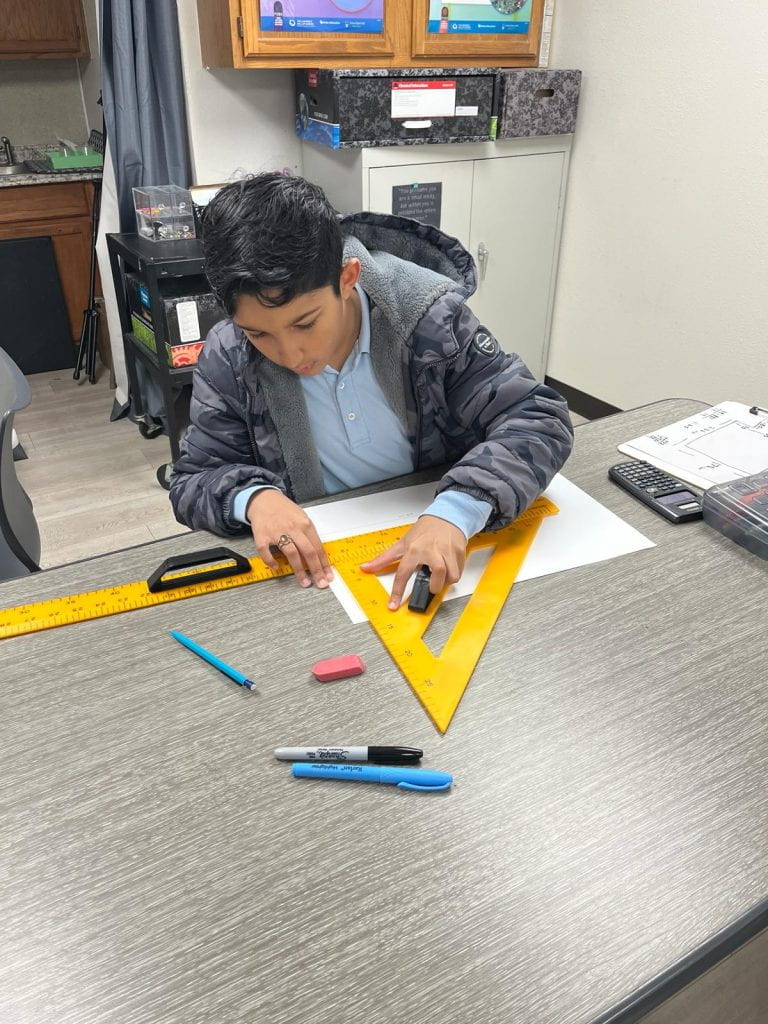
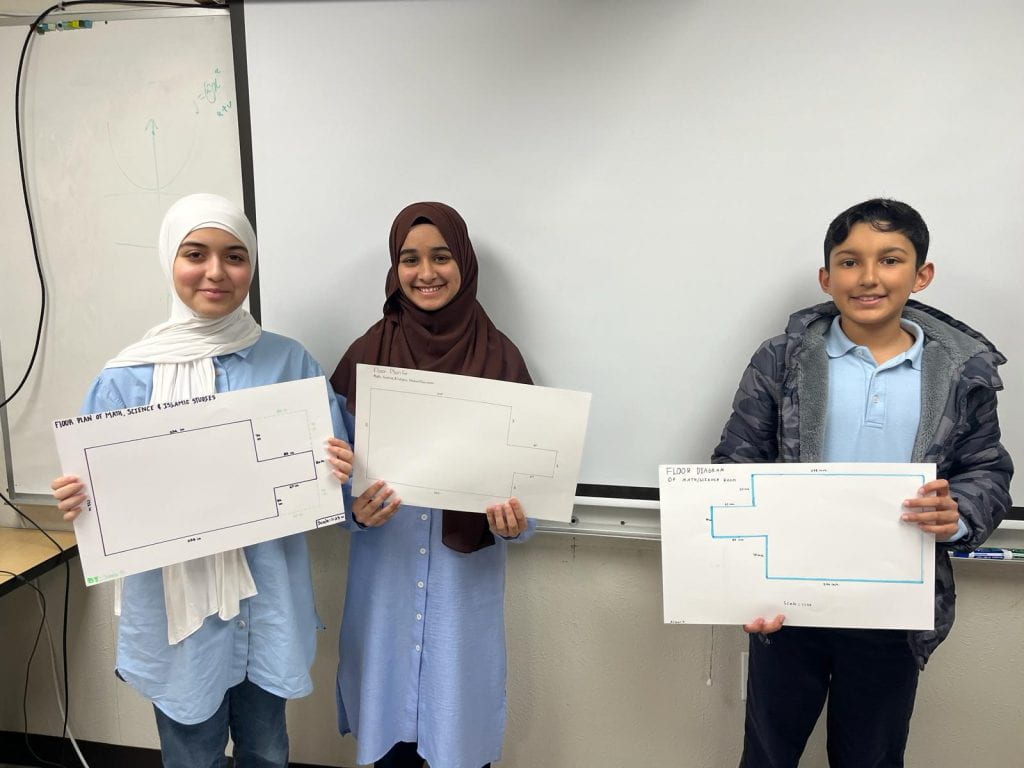
In Mathematics, grade 7 students continued studying volumes and surface areas of solids, where they practiced converting between different units of measurements of length, area, and volume. Later students studied scale drawings and maps to evaluate actual lengths and areas using a given scale, and they used this understanding to generate a floor plan for their own classroom after identifying the most reasonable scale to use. Students were also introduced to direct and indirect proportion, and recognized these relations from tables, graphs, equations and verbal descriptions of proportional relationships as they solved problems.
In Geometry, grade 9 students examined several aspects of coordinate geometry and generalized their thinking about figures on the coordinate plane. They placed different types of figures on the coordinate plane to prove properties of that type of figure. They also explored circles and parabolas in the coordinate plane, where they applied coordinate geometry to establish their equations, and used them to solve problems
Grade 7 students measuring the dimensions of their classroom to develop an accurate floor plan drawn to scale.
By Mrs. Malak Charara, Science and Electives Teacher:
In Science, Grade 7 students learned more about index fossils and the law of fossil succession. They also explored the geologic time scale and how paleontologists use radioactive decay for absolute dating of records. Throughout our lessons, we discussed the type of information we can gain from organizing such data. After that, we moved on to investigate the formation of another class of rocks known as “Igneous rocks” and how their minerals form different sizes, shapes, and colors of magnificent crystals.
In Elective Nutrition, Grade 7 students resumed learning about the third category of energy-yielding nutrients – Proteins. We discussed the dietary recommendations based on various factors, complete and incomplete protein sources based on their content of essential amino acids – which are the building blocks of proteins, and some concerns regarding their excessive consumption and deficiency. We also touched on the types of vegetarianism, pros, and cons and whether this diet approach aligns with our Islamic teachings related to animal-derived food consumption.
In Biology, our Grade 9 student explored how molecular biologists use restriction enzymes, gel electrophoresis, and DNA sequencing technologies to study the human genome. We have also explored the new methods of genetic engineering including identifying genes, amplifying DNA using polymerase chain reaction (PCR), designing recombinant DNA and using it to produce transgenic organisms. We wrapped up our Genetics unit by discussing the applications of biotechnology in the form of transgenic or genetically modified crops and animals for food, genetic methods for combating disease and even detecting viral infections like the test that was used to detect COVID-19 at the beginning of the pandemic – the PCR test! Next, we moved on to explore a new unit of “Evolution”. We discussed the processes of natural and artificial selection, evidence of evolution that are concurred by our Islamic believes and how they serve as reminders of Allah’s (swt) divine creation.
Grade 7 students revealing their hand made fossils!
Grade 7 students preparing their DIY fossil dig
Grade 7 students working on making their own colorful crystals in class!
And this is how they turned out!
Grade 7 students preparing some zaatar and cheese pies for a taste test!
Mariam explaining some of the cons of a vegan diet.
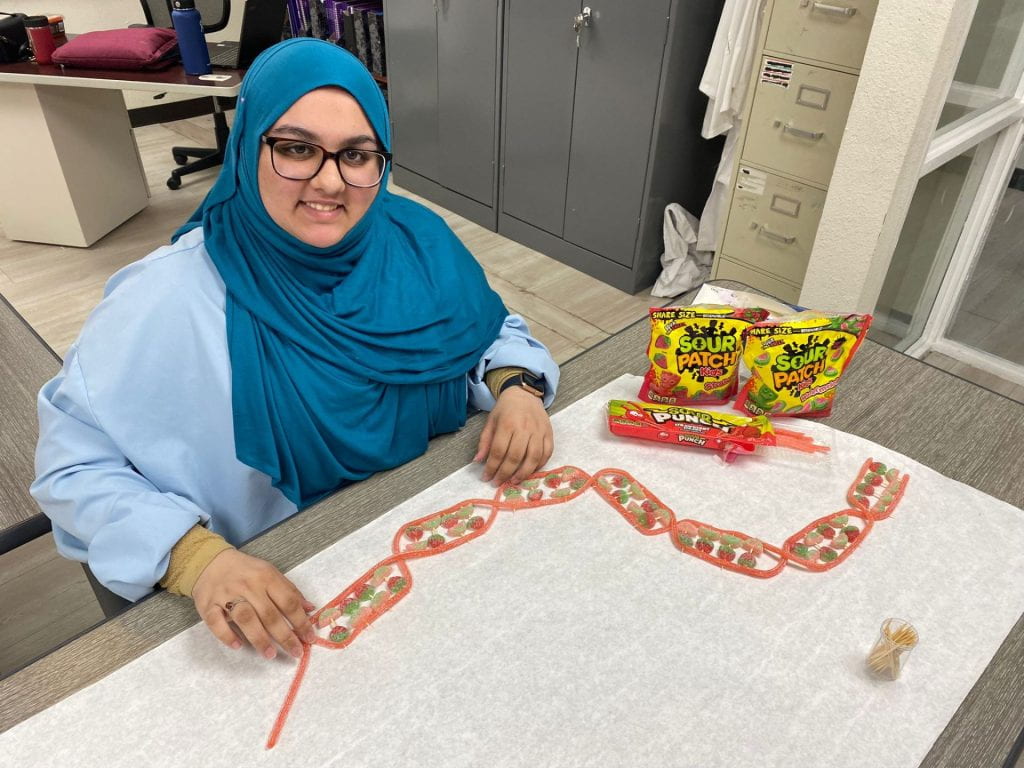
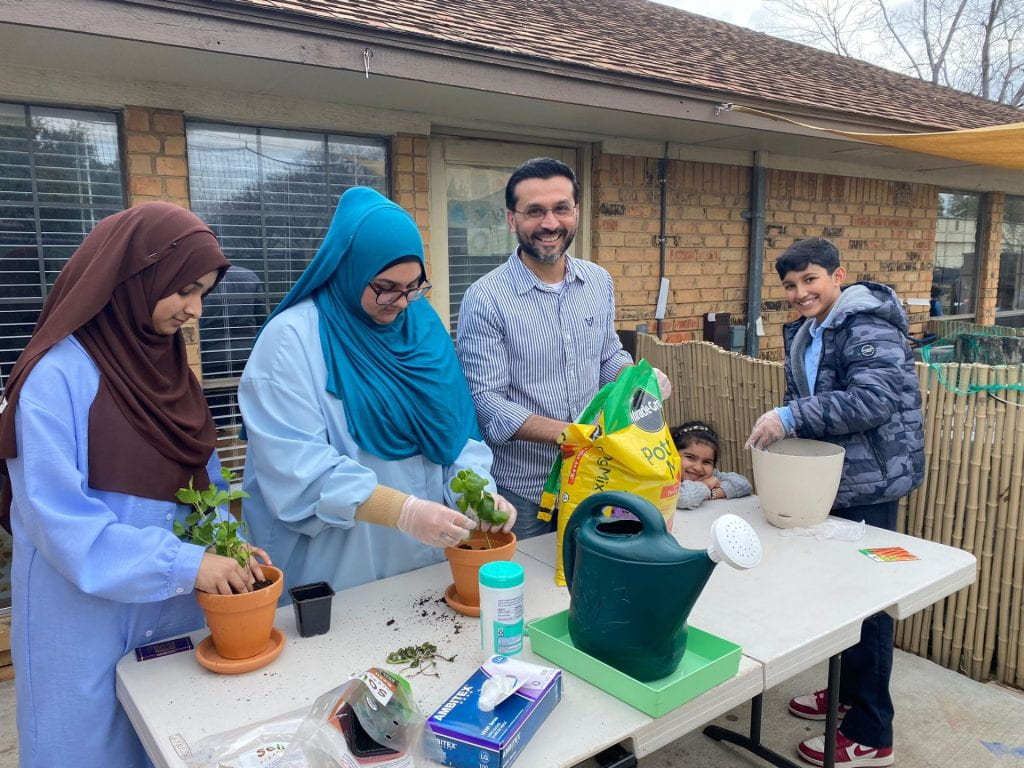
Our Grade 9 student – Sakina – worked on building a 3D model for part of our own insulin coding gene to show the DNA’s double helix structure using sour patch and sour punch! Their order was aligned with a key to explain the sequence of the complementary base pairs coding for that segment of the gene.Our upper school students enjoyed planting some seeds and herbs with their parents like carrot seeds, basil, and mint as we welcomed the spring equinox for the year 2024. We appreciate our parents’ participation in these simple, yet joyful and environmentally friendly activities!
By Br. Yusuf Ali, English, History, and Social Studies Teacher:
In social studies, the 7th graders are studying Civilizations of the Americas, including the Maya, Aztec, and Inca civilizations. Each student volunteered to study one of the topics in each unit and prepare lessons on their topics, which they will present to the rest of the class.
In the 9th grade world history course, we have begun Unit 5 of the textbook, which is entitled “A World in Crisis,” which covers the 20th century up until World War II. We have also continued working on a research project on how the modern-day Muslim world, particularly the Arab regions and Palestine have been shaped by the Western imperialist aspirations and conflicts that caused World War I and II.
In English, both classes are completing their novel units. The 7th graders have completed The Prince and the Pauper by Mark Twain, and have begun writing literary analysis papers with a focus on analyzing character, plot, and setting. The 9th grade class has completed A Tale of Two Cities by Charles Dickens, as well as a literary analysis paper focused on themes, motifs, and symbolism in the novel.
In Mathematics, Grade 7 students built on their previous knowledge of inequalities to learn about the basics of solving inequalities in one variable, visualizing their solutions on the number line, and applying this process to solve inequality problems. They then moved on to Geometry, where they extended their understanding of areas and perimeters to include plane figures like quadrilaterals, circles, and even composite figures. They explored and derived the formulas by themselves through class activities. Students later studied 3D models of Geometric Solids where they calculated their volumes and identified their cross sections, and also practiced drawing their 2D net to provide them a better understanding of the total surface area.
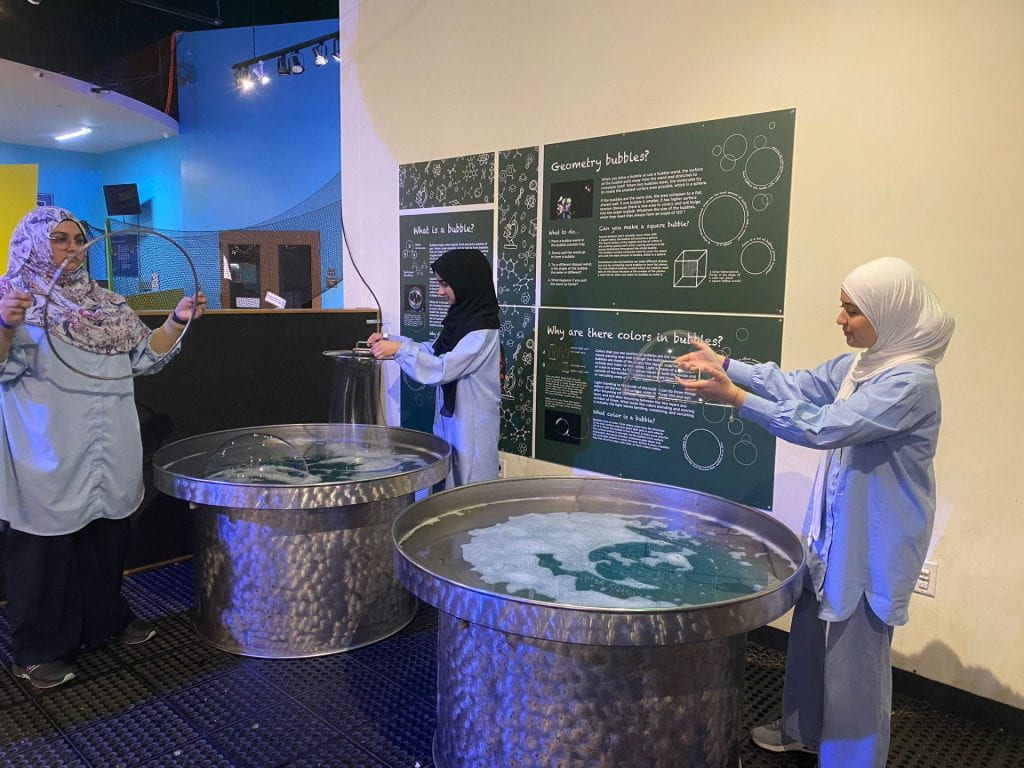
Grade 7 students deriving the area of a circle using the area of the rectangle in an activity.Grade 7 students solving a Geometry problem as a group.Grade 7 students exploring the 2D net of a solid to understand its total surface area.Grade 7 students trying to find the area of a parallelogram and taking measurements.Grade 7 students calculating the slope of a wooden stick by measuring its rise and run.Grade 7 students measuring the diameter of a round bubble table on their field trip to calculate its area.
In Geometry, Grade 9 students used properties of similar triangles and properties of parallel lines and transversals to learn and prove new theorems, and applied these theorems to find lengths in problems. Then they began applying properties of similar right triangles to understand the Pythagorean Theorem, relationships in special right triangles, and trigonometric ratios. Students then extended their understanding of trigonometric ratios to include the Law of Sines and Law of Cosines. Finally, students applied what they have learned to various contextual problems, and they also implemented a Trigonometry STEM Project to find the height of the Science Tech Discovery building on their field trip.
Grade 9 student creating her own Clinometer in a STEM project.Grade 9 student measuring the distance between herself and the Science-Tech Discovery building.Grade 9 student measuring the angle of elevation at her line of sight using the Clinometer that she created.Grade 9 student presenting her project after calculating the height of the Science-Tech Discovery building using Trigonometry.
By Mrs. Malak Charara, Science and Electives Teacher:
In Biology, and after we had studied last month about our patterns of inheritance, our Grade 9 student was introduced to the research on DNA – our genetic information, its structure and function, from both a historical and scientific perspective. We’ve also studied how DNA is copied/replicated before cell division takes place in organisms. RNA, another mesmerizing molecule we need in our lives, was compared to DNA in terms of types, structure, and function. The central dogma of genetics was then investigated to learn how genes are expressed, or in simple words, how the flow of genetic information takes place from our DNA to RNA all the way to protein production. Types of errors happening along the way, the mutations they result in, and their significance were also part of our discussions.
Our Grade 9 student worked on extracting strawberry DNA! And observing it under the microscope. It was successful Alhamdulillah!
In Science, Grade 7 students explored the phenomena of sedimentary rock, shale, and limestone formation. We grasped the concept of uniformitarianism (present rock layers provide evidence of Earth’s landscapes from the past) and the concept of superposition (the oldest rock layers are at the bottom and the newest layers are at the top). We started investigating fossils generally and will be learning more about them in the upcoming lessons.
In Elective Nutrition, Grade 7 students moved on to learn about the third category of energy-yielding nutrients – Proteins. We discussed the importance of proteins for growth and maintenance, production of enzymes, hormones, and antibodies. Additionally, regulating many processes in our bodies such as transport of other nutrients, pH levels, fluids, and electrolytes.
Grade 7 students observing some soil samples they collected 3 different outdoor areas at our school.Grade 7 students sharing their presentations on saturated fat and trans-fats’ excessive consumption and their relation to cardiovascular diseases (CVD).Grade 7 students presenting their research assignments on vegan diet and what type of protein do they consume vs. what they are missing on!Grade 7 students preparing chocolate ice-cream! With the help of the ice-cream maker.
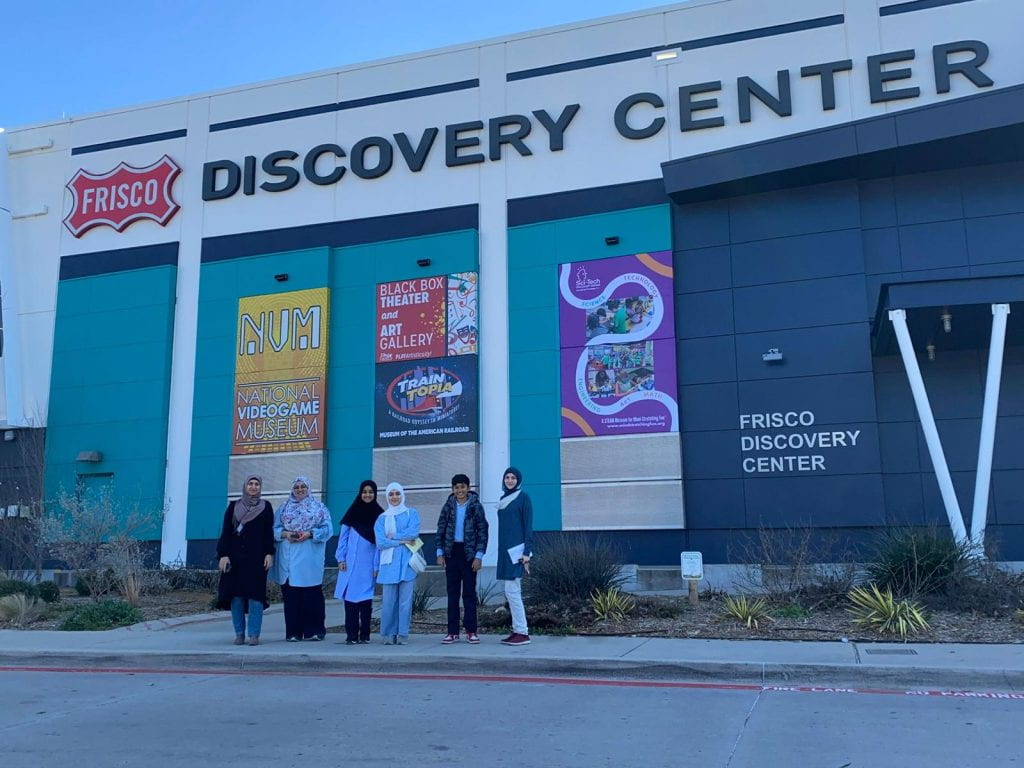
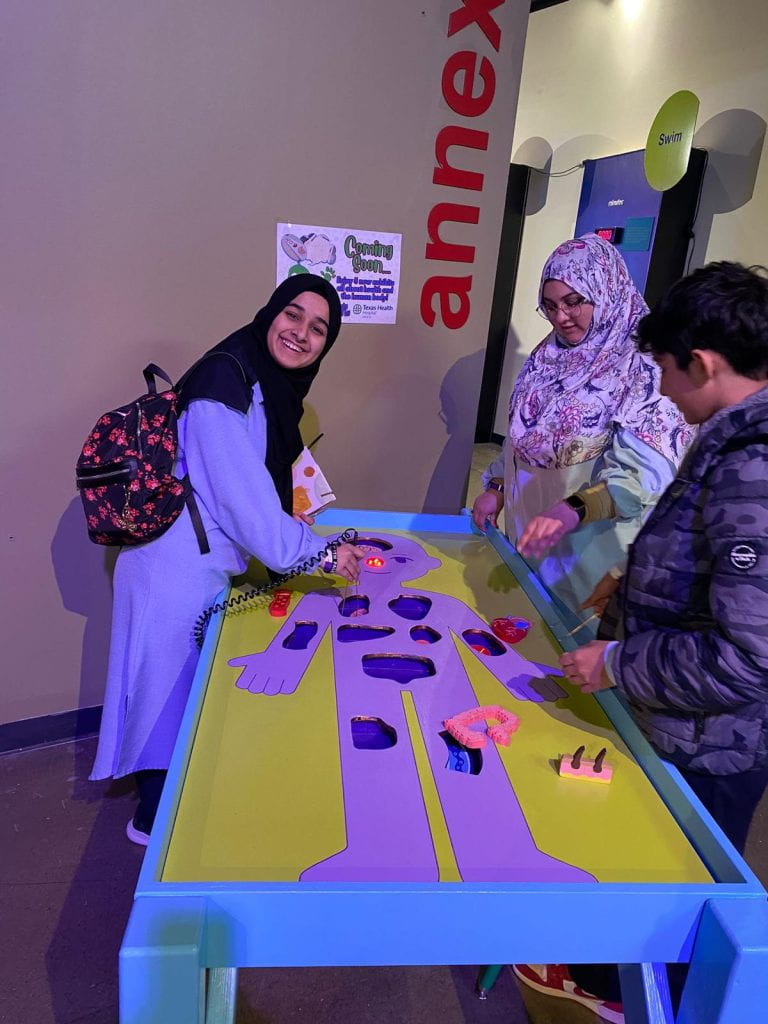
Our Upper school students enjoyed their field trip to the Sci-Tech Discovery Center in Frisco where they explored hands-on learning opportunities which inspire discovery and innovation through the exploration of science, math, and technology. They were able to apply concepts they learned in class to real world settings:
By Br. Yusuf Ali, English, History, and Social Studies Teacher:
In social studies, the 7th graders are studying Medieval Japan, beginning with the rise of the Fujiwara family and the Heian golden age of Japanese culture, and extending through the transition to the feudal military rule of the shogun, daimyos, and samurai. Each student volunteered to study one of the topics in each unit and prepare lessons on their topics, which they will present to the rest of the class.
In the 9th grade world history course, we are completing Unit 4 of the textbook, which is entitled “The Age of Revolutions,” with a detailed lesson on European imperialism during the late 19th century and early 20th century. We have also begun a research project on how the modern-day Muslim world, particularly the Arab regions and Palestine have been shaped by the Western imperialist aspirations and conflicts that caused World War I and II.
In English, both classes are continuing our novel units. The 7th graders have nearly completed The Prince and the Pauper by Mark Twain, with a focus on analyzing character, plot, and setting. The 9th grade class has completed A Tale of Two Cities by Charles Dickens, with a focus on theme, motifs, and symbolism and is preparing to write a literary analysis paper over the novel.
In Mathematics, Grade 7 students continued exploring sufficient conditions to construct unique triangles which prepares them to learn about congruence Theorems in future grades. They also established a deep knowledge in the properties of special parallelograms which helped them solve problems in squares, rectangles, parallelograms, rhombuses, and trapezoids. They then moved on to studying the Cartesian coordinate system as they identified and plotted points, represented linear equations as lines on the coordinate plane, and developed an understanding regarding the slopes of lines.
Grade 7 Group work , plotting the results on the coordinate grid and discussing them.
In Geometry, Grade 9 students related the understanding of special parallelogram properties to proving that parallelograms are squares, rectangles, or rhombuses and used them in solving problems. After that they moved on to studying similarity where they related lengths and distances in a dilated image to the pre-image using the center of dilation, and the scale factor on and off the coordinate plane. Then they described similarity in terms of rigid motions and dilation, by identifying the image of similarity transformations and identifying what kind of similarity transformation maps one figure to another. Lastly students connected the idea of similarity transformations to similarity criteria in triangles, and applied these criteria to find missing lengths and angle measures in real-world problems.
Grade 9 student exploring similarity in right triangle formed by an altitude.
By Mrs. Malak Charara, Science and Electives Teacher:
Our Upper School students were welcomed back after winter break, and it took us a while to settle back into our science lessons specially after the 2-day inclement weather as well! Grade 7 students were introduced to Geology as a branch of science that studies the Earth’s landforms and composition. We started learning about these various landforms and observed the rock formations in one of the seven wonders of the world “the Grand Canyon” as an introduction to the reminder of the semester’s lessons. Students learned about the human history of the Grand Canyon and the flood experiments of the Glen Canyon Dam.
In Elective Nutrition, Grade 7 students continued to learn more about lipids as one of the main food categories in their diet. We discussed the importance of lipids as a source of energy and a precursor for many essential hormones and fat-soluble vitamins in our bodies, the dietary recommendations, visible and non-visible fat in food and some concerns regarding their excessive consumption and deficiency.
Grade 7 students presenting their research assignment on keto diet, its benefits, and harms.
Grade 7 students tasting zaatar with olive oil and olives as good sources of healthy lipids.
In Biology, our Grade 9 student moved on to a new unit this semester to study more about genetics. We discussed topics like cell division and how cancer is related to cell cycle disturbance and touched on stem cells and cell differentiation. Gregor Mendel’s experiments on pea plants and the genetic principles that were concluded were also introduced and we learned about how our genes are inherited from one generation to the other and what role they play in shaping our physical characteristics and traits. Exceptions to Mendel’s principles were also discussed and applied to many human traits among us.
Our Grade 9 student worked on simulating segregation to further understand Mende’s law of segregation using red and white paper clips.
By Br. Yusuf Ali, English, History, and Social Studies Teacher:
In Social Studies, the 7th Graders are studying Imperial China, with a focus on the political, economic, and technological developments of the Tang and Song dynasties. Each student volunteered to study one of the topics in each unit and prepare lessons on their topics, which they will present to the rest of the class.
In the 9th Grade World History course, we are studying Unit 4 of the textbook, which is entitled “The Age of Revolutions,” with topics such as the political revolutions of Europe and the Americas in the 18th and early 19th centuries and the industrial revolution.
In English, both classes are continuing our novel units. The 7th Graders are reading The Prince and the Pauper by Mark Twain, with a focus on analyzing character, plot, and setting. The 9th Grade class is reading A Tale of Two Cities by Charles Dickens, with a focus on theme, motifs, and symbolism.
Upper school students enjoying their lunch at Dimassi’s Mediterranean restaurant with Br. Aaron, Sh. Mohammed, Sr. Kaneez, and Sr. Malak during the last week of school before winter break.
By Mrs. Malak Charara, Science and Electives Teacher:
In Science, Grade 7 students continued their investigations about changes that happen on a particles level when matter is heated or cooled. Through their lab experiments, they were able to observe changes in temperature and learned how to calculate the changes in thermal energy in calories, taking into account the mass and change in temperature of that matter. They also understood the criteria and constraints when it comes to engineering designs of thermoses that keep our beverages hot and double-paned windows to keep buildings warm during winter.
Grade 7 investigating how adding or removing thermal energy changes the phrases of matter in wax and sugar.
Grade 7 experimenting on substances to see which, if added to ice, would drop its temperature below 0 degree Celcius
Limiting factors in chemical reactions using citric acid / baking sodaAtoms re-arrangement in chemical reactions using limewater
In Elective Nutrition, Grade 7 students learned about factors that affect their daily needs of nutrients and how much of each food category their body needs through MyPlate. We discussed ways to include more fruits and vegetables in their meals and snacks. They also learned how to calculate the amount of added sugar in pre-made and bought food and assess how much in percentage it takes from their healthy carbohydrate daily needs. Students were able to identify the snack/food that they need to eat less from to minimize added sugar consumption. Remember, cutting down added sugars completely is not a realistic goal for our teenagers, yet reducing it with time and helping them choose better options for their sweet tooth from natural resources is.
Grade 7 students presenting their assignment to research different types of oats on the market in terms of production and glycemic index per serving:
Preparing granola with healthy ingredients such as honey, coconut oil, oats, seeds, and raisinsTasting various types of seeds (pumpkin, sesame, flax, pomegranate and watermelon) as part of researching lipid sources
In Biology, Grade 9 students started with a new unit this month to study about global populations and ecosystems. We investigated energy flow and cycling of elements and matter through the four spheres we have on Earth (atmosphere, geosphere, hydrosphere and biosphere). Students also studied about communities and ecosystems’ dynamics that help us understand the relationship between organisms among each other and the effect of biotic and abiotic factors in their environments on them, as well as factors that limit the growth of populations and its relation to extinction of species.
Grade 9 separating photosynthetic pigments from spinach leaves using Thin Layer Chromatography (TLC) paper and investigating cellular respiration in yeast.
Grade 9 detecting dialysis using glucose and starch solutions Grade 9 measuring the pH of the microbiome and observing it
In Mathematics, grade 7 students learned how to simplify and use ratios of two or more quantities, they also studied rate and speed. Later students practiced unit conversions and applied the acquired knowledge to solve real-world problems involving ratio, rate, and speed. Students also learned about percentages and how to solve problems involving percentage increase or decrease. Their knowledge in percentages was extended to understanding the math behind discounts and sales tax in a percent shopping project, where each student created their own shop sale poster and calculated their own bill after sales tax and discounts. Lastly our students started recalling basic geometry concepts and applied new theorems to solve problems.
Grade 7 applying ratios of 2 or more quantitiesClassworkGroup work to solve problems and discuss conclusionsPresenting their shops to classmates in a percent shopping projectCalculating their bill including discounts and sales tax after shopping in their classmates’ shopsInvestigating the sufficient conditions to form a triangle
In Geometry, grade 9 students continued learning about congruence in right triangles and applied congruence criteria in problems involving overlapping and multiple triangles. Later students extrapolated their knowledge in special segments in triangles (like bisectors, medians and altitudes) to investigate the characteristics of their points of concurrencies. They learned how to locate and construct the circumcenter, incenter, centroid and orthocenter, and decide which point of concurrency is needed to solve a specific problem. Students also identified the relationships between angle measures and side lengths in triangles after addressing inequality theorems. Lastly our students moved on to investigating the interior and exterior angles of polygons, examining properties of kites and trapezoids, and then differentiating the properties and conditions of parallelograms and special parallelograms. These properties were used to implement a STEM project: building a parallelogram hydraulic lift.
Grade 9 constructing the orthocenter of a triangle
Balancing the center of mass by locating the centroidParallelogram hydraulic lift projectTesting the effectiveness of the lift
By Br. Yusuf Ali, English, History, and Social Studies Teacher:
In social studies, the 7th graders completed their study of Unit 2: Islam in Medieval Times and Unit 3: The Culture and Kingdoms of West Africa. Each student volunteered to study one of the topics in each unit and prepare lessons and quizzes on their topics. They presented their lessons to the rest of the class and assessed their classmates’ learning using their quizzes.
In the 9th grade world history course, the students have completed their study of Unit 3: The First Global Age, with lessons on early modern tranformations in different societies and regions of the globe, including the Muslim world, China, western Europe, and the Americas. Some of the topics included European colonialism and the globalization of trade and commerce.
In English, both classes have begun novel units. The 7th graders are reading The Prince and the Pauper by Mark Twain and 9th grade is reading A Tale of Two Cities by Charles Dickens. We completed the grammar unit on the ten sentence patterns of the English language and are not continuing with a study of the different types of clauses and phrases.
By Br. Yusuf Ali, English, History, and Social Studies Teacher:
In social studies, the 7th graders completed their study of Unit 1, Europe During Medieval Times, with lessons about the Roman Catholic Church in medieval Europe, life in medieval towns, the decline of feudalism and the Byzantine Empire. They have begun our study of Unit 2, Islam in Medieval Times. Each student has volunteered to study one of the topics in the unit and prepare a lesson and quiz on their topic. They will present their lessons to the rest of the class and assess their classmates’ learning using their quizzes.
In the 9th grade world history course, the students have completed their study of Unit 1, The Foundations of World History, and Unit 2, The World before 1750, which covers the rise of the new major civilizations that replaced the empires of the ancient world, such as the Muslim empire, Byzantine empire, and Tang dynasty in China, as well as civilizations in West Africa and the Americas. We also began Unit 3, The First Global Age and the 9th grade students are preparing a presentation and quiz for the 7th graders on the “Gunpower Empires” of the Ottomans, Safavids, and Mughals.
In English, both classes have continued their units on short stories, practicing their skills at interpreting and analyzing literary texts. The 7th graders used what they learned to write their own original short stories utilizing some of the advanced literary devices, such as frequent changes of narrative perspective, that they encountered in the stories we studied. The 9th graders engaged in deep thinking and analysis of more sophisticated literary texts that dealt with themes of social injustice and generational understanding.
In Mathematics, grade 7 students learned the basics of algebraic manipulations. They worked on simplification, expansion, and factorization of algebraic expressions by extracting common factors and grouping terms. They were also introduced to factorization of algebraic expressions using area models. Later students practiced solving equations and getting the solutions of both linear and fractional equations, and discovered how to find out the number of solutions of an equation, if there is any. Finally connecting everything they learned, students applied the acquired knowledge to form linear equations in order to solve real-world problems.
Grade 7 students working on Factorization using Area Models for a class activity
Grade 7 students learned how to create their own Math puzzles using Algebra and presented them in class.Grade 7 students applied Algebraic Manipulations in order to solve formulas
Grade 7 students practiced identifying Equivalent Algebraic Equations using Algebra tiles online
In Geometry, grade 9 students learned about different kinds of rigid motions including reflection, translation, rotation, and glide reflection, and how to construct these transformations with and without the coordinate system. They were also introduced to symmetry and its relation to rigid motions. Later students learned about triangle congruence where new theorems were introduced and used in writing proofs. Using what the learned about congruent triangles, students worked on a bridge building project to see how triangles play a huge role in the stability and sturdiness of constructions.
Grade 9 students worked on a Truss Bridge Project. The bridge was tested to hold up to 50 pounds of weight!
By Mrs. Malak Charara, Science and Electives Teacher:
– In Science, Grade 7 students continued their investigations about changes that happen on a particles level when matter is heated or cooled. Through their lab experiments, they were able to observe changes in temperature and learned how to calculate the changes in thermal energy in calories, taking into account the mass and change in temperature of that matter. They also understood the criteria and constraints when it comes to engineering designs of thermoses that keep our beverages hot and double-paned windows to keep buildings warm during winter.
Grade 7 students learning about the phenomenon of thermal energy transfer between hot and cold liquids. Grade 7 students investigating the difference between dissolving and melting of solids using colorful skittles. Grade 7 students investigating filtration as a method to separate solutes from solvents in solutions.
– In Elective Nutrition, Grade 7 students learned about factors that affect their daily needs of nutrients and how much of each food category their body needs through MyPlate. We discussed ways to include more fruits and vegetables in their meals and snacks. They also learned how to calculate the amount of added sugar in pre-made and bought food and assess how much in percentage it takes from their healthy carbohydrate daily needs. Students were able to identify the snack/food that they need to eat less from to minimize added sugar consumption. Remember, cutting down added sugars completely is not a realistic goal for our teenagers, yet reducing it with time and helping them choose better options for their sweet tooth from natural resources is.
Grade 7 students sharing healthy snack ideas and ways to include more fruits and vegetables in their diet throughout the day.Grade 7 students presenting their assessment of how much carbohydrates, including added sugars they consume in a day.Grade 7 students preparing both salty and cinnamon sugar pretzel bites.
– In Biology, Grade 9 students started with a new unit this month to study about global populations and ecosystems. We investigated energy flow and cycling of elements and matter through the four spheres we have on Earth (atmosphere, geosphere, hydrosphere and biosphere). Students also studied about communities and ecosystems’ dynamics that help us understand the relationship between organisms among each other and the effect of biotic and abiotic factors in their environments on them, as well as factors that limit the growth of populations and its relation to extinction of species.
Our Grade 9 student taking care of her flower seedlings, they are exactly one month old now! Our Grade 9 student presenting and explaining the lesson: “Habitat, Niches and Species Interactions” to upper elementary students as part of her presentation assignment.
By Br. Yusuf Ali, English and Social Studies Teacher:
In social studies, the 7th graders have begun their study of Unit 1, Europe During Medieval Times, with lessons about the legacy of the Roman Empire and the development of feudalism in Western Europe. They wrote a timed, in-class essay exam with a minimum requirement of 600 words about the various ways in which the culture of the Roman Empire, such as architecture, art, engineering, philosophy, political structures, and language, have influenced and continue to influence Western culture and civilization today. We also had a oral discussion exam about the feudal system of medieval Europe.
In the 9th grade world history course, the students have started their study of Unit 1, The Foundations of World History, which deals first with a discussion of different aspects and issues that arise in the study of history, and then a survey of early humanity’s cultural development from life as bands of hunter-gatherers to the ancient civilizations enabled by the rise of agricultural knowledge and practices. They also wrote a timed, in-class essay exam on that topic to demonstrate their mastery of those ideas.
In English, both classes have begun a unit on short stories, practicing their skills at interpreting and analyzing literary texts. The 7th graders used what they learned to write their own original short stories utilizing some of the advanced literary devices, such as frequent changes of narrative perspective, that they encountered in the stories we studied. The 9th graders engaged in deep thinking and analysis of more sophisticated literary texts that dealt with themes of social injustice and generational understanding.
By Mrs. Batool Kamar, Math Teacher:
Grade 7 students exploring and identifying like terms and unlike terms in an introduction to algebraic manipulation. Grade 9 students visualizing geometric transformations like reflection, translation, and rotation, and using their understanding of rigid motion to create an image from a pre-image.
By Mrs. Malak Charara, Science and Electives Teacher:
In Science, Grade 7 students continued to learn more about the properties of matter and the changes that happen on a particles level when compressed, expanded, cooled, or even heated. Through their lab experiments, they were able to observe if there were any changes in all three states of matter (solids, liquids, and gases) and understand the theory part of their lessons better since particles are too small to be seen with our unaided eyes.
In Elective Nutrition, Grade 7 students learned how to read and analyze the nutritional facts labels on items they buy and consume on a regular basis like milk, cereal, and favorite snacks! We’ll be learning more about the nutrient groups in detail in upcoming classes Insh’Allah. They also learned the difference between organic and inorganic food, what it really means and whether or not it makes a difference to their overall health.
In Biology, Grade 9 students studied about the chemistry of life this month, yes as you read “chemistry” because in order for us to understand the biology of living things we need to look at what interactions are happening within and around us and this requires a background knowledge of chemistry. Their investigations included topics like the nature of matter, properties of water, carbon compounds, energy in chemical reactions and enzyme activity in our biological systems.
Grade 7 students trying to capture the gas produced from a chemical reaction and measuring its volume using a measuring syringe.
Grade 9 students detecting the pH value of samples they eat, drink, or use every day. Grade 7 students investigating compression, expansion cooling and heating in the three states of matter (solids, liquids, and gases) and explaining their experiments to upper Elementary students.
Grade 7 students investigating the properties of air around them as a good example of a gaseous matter.
Grade 7 students presenting and analyzing nutritional information of their favorite dish.