Wisdom Academy: April and May 2024

In the Name of God, the Beneficent, the Merciful

Primary Class News

By Tasneem Mamdani, Primary Guide

Salaam Dear Parents,

Alhumdulillah, we have successfully completed another wonderful year at Wisdom Academy. As we reach the end of 2024, I would like to take a moment to reflect on the incredible journey we’ve shared together. From the very first day of school to our special events and enriching activities, this year has been filled with joy, learning, and growth.

As the academic year comes to a close, we thank Allah (SWT) and Ahlul Bayt (A.S.) for guiding and blessing us through another year. It has been a year brimming with laughter, curiosity, and remarkable growth.

Year at a Glance

Our year began with excitement as the children settled into their new environment, forming friendships and discovering the joy of learning. We celebrated numerous events and engaged in a variety of educational activities that have left lasting impressions on our young minds.

Highlights of the Year

  • Yuam e Hussain
  • Mother’s Day & Father’s Day
  • Maulud al Hujjah
  • Pumpkin Experiment
  • Eid Carnival
  • Planting with Parents
  • Hatching Chicks

Life Cycle of a Butterfly

The children were fascinated by the life cycle of a butterfly. They observed the transformation from caterpillar to chrysalis to butterfly, learning about nature’s wonders firsthand. This hands-on experience was both educational and enchanting, sparking curiosity and a love for nature.

Graduation: The culmination of our year was the graduation ceremony. It was a proud moment for all of us as we celebrated the achievements of our young graduates. As they start their second phase of development, we are excited to see them continue to thrive and succeed.

And Much More…

From art projects to science experiments, story time to outdoor play, every moment at Wisdom Academy has been filled with learning and joy. The children’s enthusiasm and curiosity have been a source of inspiration for all of us.

Year at a Glance Through Pictures

While words can capture the essence of our experiences, pictures tell the story more vividly. We have compiled a collection of photos that highlight these special moments, showcasing the smiles, creativity, and learning that have defined our year.

As we look back on this incredible year, I am filled with gratitude for the support of our parents, the dedication of our supportive staff, and the enthusiasm of our wonderful students. Thank you for being a part of the Wisdom Academy family. We look forward to another year of growth, learning, and joy.

May Allah’s blessing be upon each and every one of you during this break. We look forward to reuniting with you after the summer, as we continue this beautiful journey of learning and discovery together.

Until then, stay safe and take care.

Warm regards,

Mrs. Tasneem Mamdani

CLICK HERE FOR MORE PRIMARY CLASS PHOTOS!


Primary 2 Class News

By Mrs. Fizza Rizvi, Primary 2 Guide

Here’s a glimpse into our last 2 months of the 2023-2024 school year!


Quran Studies News

By Mrs. Fadia Ali, Quran Studies Teacher

Alsalamu Alikum Dear Parents,
I pray that you and your family are all well and having a great summer break Insha’Allah. Here is a summary of your children’s Qur’an work during April & May, 2024.

Primary:
Level One: (4 years old and 5 years old children who joined the Quran program for the first time this year) Children reviewed all previous Surahs and Duaa’s which they learned throughout this year.
Level Two: (5 years old children) Children practiced Surah Al Adiyatt العَادِيات and part one of Ayah Al Kursi الكُرسي أيَة. They also reviewed all previous Surahs and Duaa’s which they learned this year.
We usually focus in these two primary levels on the correct (Makharyge) مَخارِج and pronunciation of Arabic letters and words, and on memorization of number of small Surahs and Duaa’s the correct way. (All Duaa’s are from the Noble Qur’an)


Elementary:
Group One (level two Qur’an): Students continued reading Juza 30th of the Nobel Quran after they finished reading grammars (the Qaida).
Group Two (level two Qur’an): Students continued reading the last two Juzas of the Nobel Quran (reading without repetition). They also continued practicing Surah Al Qyamah القِيامة سورة.
Group Three (level two Qur’an): Students continued reading Surah Al Baqharah البَقَرة سورة (reading without repetition). They also continued practicing Surah Al Qyamah القِيامة سورة.
Our main focus at level two (groups two and three) is on improving student’s recitation of the Noble Quran.
Groups Four and Five (level three Qur’an): Students have finished reading Surah Al Baqharah البَقَرة (reading without repetition), while they are still practicing Surah Al Mulk المُلك سورة.
Our focus at level 3 (groups four & five) is on reading, on Qur’an vocabulary memorization, and on writing; our goal is to help children learn the most efficient way of Arabic writing, and to help them develop a sense of direction of their Arabic writing (which is opposite of the direction of English writing), and develop a sense of the right size of the Arabic written words.

Middle School:
7th grade: Students reviewed Tajweed rules in more details and applied them while reciting part 1 to 7 of Surah Al Kahf الكَهف سورة (pages 1 to 14 of Surah Al Kahf), they also learned new Hadeeth of the Prophet and Ahlulbaiyt (as) (Hadeeth The best action & Hadeeth Maintenance of Continuous action), and Quran Quest; (Surah Al Adiyatt العَادِيات سورة & Surah Al Fil سورة الفيل).
High School:
9th grade: Student learned Chapters 7 of the No nonsense Arabic book (The past and present passive voice verbs). They also finished reciting the Nobel Quran during the month of Ramadan and continued, after the month of Ramadan, their daily recitation of different Surahs while applying all learned Tajweed rules.


Elementary Class News

By Ms. Hind Sabir, Elementary Guide

Salaam Dearest Parents of the Elementary,
As the doors of 2023-24 slammed shut as quickly as they flew open, the year began to ramp up rather than settle down these last couple of months. It was a bittersweet realization for much of our children who were saddened by the coming of the end – a true testament to the amazing work and spirit within Wisdom walls, ‘ . ال حمد Ultimately, the children began to take stock and reflect upon the people they want to become and how they want to return from summer. Summer is a great time to relax, travel, have fun, reconnect, and fine tune. Don’t underestimate the power within our children – they are amazing with their 90 billion neurons each! Reading, fiction and especially non-fiction, is always a great summer work that brings adventures and self-construction. While screens can bring the damage of deviations and inactivity evident to the body but more menacing and subversive to the brain. Limiting screen time is critical to a still-forming mind that needs to take a role in executive function when your child can make well-planned decisions that will further them as an individual.

Have a safe, healthy, and blessed summer full of wonders!
See you in August!

CLICK HERE FOR THE ELEMENTARY CLASS PHOTO GALLERY!


By Mrs. Malak Charara, Science and Electives Teacher:

In Science, Grade 7 students learned more about plate boundaries and the “Plate Tectonics” theory which explains the science behind how some parts of our Earth’s lithosphere have been moving slowly over millions of years and shaping the continents we know and live on today. After that, we moved on to investigate the formation of another class of rocks known as “Metamorphic rocks” and how all three types of rocks can undergo metamorphism and change to one another in what is known as the “Rock Cycle”. Finally, we studied some geological phenomena such as earthquakes and volcanoes and concluded the semester by researching mesmerizing Geoscenarios that help remind us of Allah (swt)’s divine creation.

In Elective Nutrition, Grade 7 students learned about the essential micronutrients we need to survive, specifically vitamins. Students were introduced to the different categories, names and functions. We touched on some fun facts for selected vitamins as well and researched some disorders related to excess or deficient intake of some of the main vitamins like A, C and D.

In Biology, our Grade 9 student resumed her exploration in the unit of evolution as we tackled topics like evolutionary patterns and processes and finding order in Biodiversity to classify organisms based on various factors. The latter was a foundational lesson to introduce the last unit of study (Unit 6: The Diversity of Life). Each lesson in this unit explored a different group of microbes (viruses, prokaryotes, protists, and fungi), defined the group, the general structure, common reproductive strategies, and the roles of group members in the environment. We discussed real world examples of impacts to human health and how understanding disease-causing organisms helps us control them and prevent future epidemics. Next, we touched on the Plantae and Animalia Kingdoms in the same aspect and concluded the semester by investigating the complex systems and feedback methods that work together to maintain homeostasis in the human body. We learned about the structures and functions of the following systems: digestive, excretory, circulatory, lymphatic, immune, respiratory, nervous, skeletal, muscular, endocrine, and male and female reproductive systems.

As we come to an end to this fruitful academic year Alhamdulillah, I would like to thank our students and you as parents for all the time and effort you’ve put towards success and progress! Here are some photos from April and May 2024!

Grade 7 students presenting their three different Geoscenarios: Yellowstone Hotspots (by Alizar), Glaciers (by Sara) and Oil (by Mariam) as a final project to summarize and apply the Earth History lessons and concepts they’ve been investigating this semester:

Our Grade 7 students chopping some Fattoush vegetables for a taste test!

Grade 7 student preparing and decorating some dark chocolate covered strawberries as a healthy treat:

Grade 7 students sharing their presentations on vitamin D deficiency disorders in children and adolescence, their symptoms, and ways to include more vitamin D rich food into their daily intake to prevent such disorders:

Grade 7 students sharing their presentations on “Kwashiorkor” a protein deficiency disorder, it’s symptoms and how to include more protein in their diets to meet the Recommended Daily Allowance (RDA) and prevent establishing this disorder:

Our Grade 9 student enjoying some break time with the elementary chicks!

Our Upper School students enjoyed celebrating Eid A-Fitr with their annual “Secret Eid” tradition, Alhamdulillah — there were lots of gifts and joyful moments with their peers and teachers:

In Mathematics, grade 7 students were provided an overview of data-collection methods, and the process of organizing and presenting data, they learned how to draw and analyze dot plots of a data set. They built on their previous understanding of the mean and median as measures of center, to learn about the mean absolute deviation (MAD) as measure of variability for numerical data. They used this knowledge to implement a survey in elementary class about the number of sports liked by each student, displayed the data set on a dot plot, analyzed and understood the results. Furthermore, 7 graders started establishing a knowledge in probability by first understanding sets and sample spaces and their notations. They investigated probabilities of compound events and found these probabilities using possibility diagrams and tree diagrams. They learned about mutually exclusive events, independent events, and dependent events and the difference in finding their probabilities.

In Geometry, grade 9 students began with an examination of arc length, sector area, and segment area, and an introduction to radians as a unit of angle measure. Students then examined properties of tangents, chords, inscribed angles, and segments lengths. They then moved on to studying cross sections, and determining the 3D figure formed by rotating a 2D figure, and applied the volume formulas for prisms, cylinders, pyramids, cones, and spheres to solve problems. Finally they extended their previous knowledge of ratios and basic probability to the probability of multiple events, combinatorics, probability distributions, expected value, and used them to make decisions.

By Br. Yusuf Ali, English, History, and Social Studies Teacher:

9th Grade Social Studies completed research into the WWI Occupation of Palestine. 7th Grade Social Studies ended the Unit on the European Renaissance. English Studies included preparation for the SAT 10 Exam.


Inshaa’Allah

Alhamdulillah! We thank the parents, families, and community for their continuing support and encouragement. If you have any questions, comments, or ideas, we would love to hear from you! Please leave your comments!

September 2023 7th and 9th Grade News

By Br. Yusuf Ali, English and Social Studies Teacher:

In social studies, the 7th graders have begun their study of Unit 1, Europe During Medieval Times, with lessons about the legacy of the Roman Empire and the development of feudalism in Western Europe. They wrote a timed, in-class essay exam with a minimum requirement of 600 words about the various ways in which the culture of the Roman Empire, such as architecture, art, engineering, philosophy, political structures, and language, have influenced and continue to influence Western culture and civilization today. We also had a oral discussion exam about the feudal system of medieval Europe.

In the 9th grade world history course, the students have started their study of Unit 1, The Foundations of World History, which deals first with a discussion of different aspects and issues that arise in the study of history, and then a survey of early humanity’s cultural development from life as bands of hunter-gatherers to the ancient civilizations enabled by the rise of agricultural knowledge and practices. They also wrote a timed, in-class essay exam on that topic to demonstrate their mastery of those ideas. 

In English, both classes have begun a unit on short stories, practicing their skills at interpreting and analyzing literary texts. The 7th graders used what they learned to write their own original short stories utilizing some of the advanced literary devices, such as frequent changes of narrative perspective, that they encountered in the stories we studied. The 9th graders engaged in deep thinking and analysis of more sophisticated literary texts that dealt with themes of social injustice and generational understanding.


By Mrs. Batool Kamar, Math Teacher:


By Mrs. Malak Charara, Science and Electives Teacher:

In Science, Grade 7 students continued to learn more about the properties of matter and the changes that happen on a particles level when compressed, expanded, cooled, or even heated. Through their lab experiments, they were able to observe if there were any changes in all three states of matter (solids, liquids, and gases) and understand the theory part of their lessons better since particles are too small to be seen with our unaided eyes.

In Elective Nutrition, Grade 7 students learned how to read and analyze the nutritional facts labels on items they buy and consume on a regular basis like milk, cereal, and favorite snacks! We’ll be learning more about the nutrient groups in detail in upcoming classes Insh’Allah. They also learned the difference between organic and inorganic food, what it really means and whether or not it makes a difference to their overall health.

In Biology, Grade 9 students studied about the chemistry of life this month, yes as you read “chemistry” because in order for us to understand the biology of living things we need to look at what interactions are happening within and around us and this requires a background knowledge of chemistry. Their investigations included topics like the nature of matter, properties of water, carbon compounds, energy in chemical reactions and enzyme activity in our biological systems.

Grade 7 students trying to capture the gas produced from a chemical reaction and measuring its volume using a measuring syringe.
Grade 7 students investigating the properties of air around them as a good example of a gaseous matter.

August 2023 7th & 9th Grade School News

By Mrs. Malak Charara, Science and Electives Teacher:

Upper School students were welcomed back into their science classes for the new academic year 2023-2024 and we also welcomed Alizar, our new enthusiastic student in Middle School.

In Science, Grade 7 students were introduced to the elements of the periodic table as the main essence of understanding chemistry. They learned about the difference between physical and chemical properties as well as the availability and abundance and uses of the most common elements on Earth.

In Elective Nutrition, Grade 7 students were introduced to nutrition and how essential it is to gain knowledge and thus awareness in this field of science for a healthier wellness starting from themselves and potentially their families if applied in their daily routine.

Grade 9 students were introduced to Biology as a vast branch of science that studies the natural world within and around us using evidence and supporting data. They reviewed what they know about the process of scientific methodology and importance of peer review and learned about the characteristics of life that define organisms.

Grade 7 students preparing and drinking a healthy smoothie of their choice that contains nutritious ingredients.
Grade 7 students trying to identify the 2 substances in their mystery mixture through its physical and chemical properties.
Grade 9 students learning about the importance of providing clear and accurate directions when writing experimental procedures and steps through the “Replicating Procedures” Lab activity.

By Ms. Batool Kamar, Math Teacher:

7th Graders watching an introductory video about negative numbers and their uses in real world problems.

By Mr. Yusuf Ali, English and Social Studies Teacher:

In English, both the 7th and 9th graders began the school year considering the purpose of school itself. I created a series of videos in which I argued that being intrinsically motivated in seeking an education is superior to being extrinsically motivated. The students watched the videos at home and took notes. In class, they wrote summaries of my argument and we discussed and analyzed the main points. The 7th graders are currently writing an essay in which they summarize my argument for intrinsic motivation and respond to it based on their own reasoning and experience. The 9th graders task is more complex, because they not only have to summarize my argument, but also analyze and evaluate it before sharing their personal response to the claims. In addition to this, we also reviewed the grammatical concepts of subjects, predicates, independent clauses, dependent clauses, prepositional phrases, and sentence types, applying these concepts to the students’ own writing.

In social studies, both the 7th and 9th graders studied the overall history of the world from about 3300 BCE to the present, including the Bronze Age, Iron Age, Classical Antiquity, Middle Ages, and the Modern Age. This, of course, was a very general overview that did not delve into details, but is intended to give the students a wide perspective from which to understand the particular civilizations and events that we study this year. Both 7th and 9th graders took an essay exam in which they explained and described the highlights of world history. The 7th graders have also begun working with their textbook for this year, History Alive! The Medieval World and Beyond, and the 9th graders with theirs, History Alive! World Connections.

August 2023 Quran and Islamic Studies

By Mawlima Fadia Ali, Quran Studies Teacher

Alsalamu Alikum Dear Parents,
Our condolences go to our beloved Prophet and his family (pbut) and to you all for the Arbaaeen of الشُهَداء سَيِّد Imam Al Husain (as) and his companions, may Allah (swt) bless their souls, defeat their enemy, and make us and you all among their followers and supporters Insha’Allah Taala.

I want to welcome you all to our new school year of 2023-2024
This is a summary of your children’s Qur’an work during the month of August, 2023:

Primary:
Level one: (4 years old and the beginners of 5 years old children) Children practiced; Basmala, Taawz, Salat upon Muhammad and Aal Muhammad (مُحمَّد آلِ و مُحمَّد على الصَلاة – التعوُّذ – البَسمَلة)
Level two: (5 years old children) Children reviewed surahs; Al Fatiha الفاتحة, Al nass الناس, Al Iqhlas الإخلاص, Al Kauthar الكوثر. They also reviewed Dua Al Ilm and Prophet Musa (as) (All Dua’as are from the Noble Qur’an)
We usually focus in these two primary levels on the correct pronunciation of the Arabic letters and words, and on the memorization of number of small Surahs and Dua’as the correct way.

Elementary:
Group One (level two Qur’an): Practiced the big Arabic letters and reviewed the five basic small surahs which are Al Fatiha الفاتحة, Al nass الناس, Al Iqhlas الإخلاص, Al Kauthar الكوثر, and Al Falaq الفَلَق.

Two and Three (level two Qur’an): reviewed the reading grammars and the five basic small surahs which are Al Fatiha الفاتحة, Al nass الناس, Al Iqhlas الإخلاص, Al Kauthar الكوثر, and Al Falaq الفَلَق. they also practiced part one of Ayah Al kursi.Group Three (level two Qur’an): reviewed the reading grammars and the five basic small surahs which are Al Fatiha الفاتحة, Al nass الناس, Al Iqhlas الإخلاص, Al Kauthar الكوثر, and Al Falaq الفَلَق. they also practiced part one of Ayah Al kursi. they also started practicing basic Arabic writing and reviewed some Arabic vocabulary (colors 1 & numbers 1) they also started composing some Arabic words, although, our main focus at these two levels is still on reading.

Group Four and Five (level three Qur’an): reviewed the five basic small surahs which are Al Fatiha الفاتحة, Al Nass الناس, Al Iqhlas الإخلاص, Al Kauthar الكوثر, and Al Falaq الفَلَق. they also practiced part one of Ayah Al kursi. Children also reviewed some of last year’s vocabulary such as (colors 1-2 & numbers 1-2)
Our focus for this year for groups four & five will be mostly on writing and reading. Our goal is to help children learn the most efficient way of Arabic writing, help them develop a sense of direction of their Arabic writing (which is opposite of their English writing), and develop a sense of the right size of the Arabic written words.

Middle School7th grade:
Group 1:
Students reviewed their memorization of Ayah AlKursi and the five small basic Quran surahs which are Al Fatiha الفاتحة, Al Nass الناس, Al Iqhlas الإخلاص, Al Kauthar الكوثر, and Al Falaq الفَلَق., and practiced reading pages 1&2 of Surah Yaseen يَس, they also memorized more Arabic words and started with Arabic grammar (The Arabic sentences).
Group 2: Students reviewed their memorization of pages 1&2 of Surah Yaseen يَس, and reviewed vocabulary chapters 1-6 of the Quran the vocabulary book. They also reviewed all grammar lessons which they learned last year.

Upper School- 9th grade:
Group 1: Students memorized part one of Ayah Al Kursi and practiced reading Ayatt Al Dayen الدَيْن آيَات (282 and 283 of Surah Al Baqhara البَقَرَة), they also reviewed vocabulary chapters 1-6 of the Quran vocabulary book. They also reviewed all grammar lessons which they learned last year.
Group 2: Students memorized Ayatt Al Dayen الدَيْن آيَات (282 and 283 of Surah Al Baqhara البَقَرَة), and reviewed vocabulary chapters 1-16 of the Quran vocabulary book. They also reviewed all grammar lessons which they learned last year.


By Sh. Mohammed Al-Saadi, Dean of Mission and Islamic Studies Teacher:

For the Upper School students, we begin everyday with an assembly that consists of the recitation of a supplication (duʿāʾ) before studying. Afterward, after sharing any pertinent announcements, the students take turns reciting and reflecting on verses of the Quran along with their translation. We began with Sūrat al-Fātiḥah and are reading Sūrat al-Baqarah at the moment. We conclude the assembly with the supplication known commonly as duʿāʾ al-faraj.

In both 7th and 9th Grade Islamic Studies, we have been following the Tarbiyah Curriculum focusing on Module 1: The Creator and His Creation and Module 2: Divine Guidance as well as supplementary reading from God’s Emissaries.

In 7th Grade, we discussed the topic of God as the creator of the universe and the importance of having faith. We also discussed God’s guidance and grace and the importance of sending prophets. In God’s Emissaries, we are discussing the life and story of Prophet Moses.

In 9th Grade, we discussed the creation of the universe as well as proofs for God’s existence. We also discussed divine guidance, focusing on the life of Prophets Jacob and Joseph, with additional reading from God’s Emissaries.

May 2023 Middle School News

By Br. Jonathan Yusuf Ali, English/Social Studies/Elective Teacher

In English, the 6th graders completed the novel Watership Down and developing their understanding of literary elements such as plot, character types, setting, and conflict. The 8th graders completed the novel Around the World in Eighty Days by Jules Verne, which has served as an entertaining introduction to the political and physical geography of the late 18th century.

In 6th grade social studies, the 6th and 8th graders collaborated on a research project on the history of the city of Carrollton. They focused on the historic downtown Carrollton area. Individually and in groups, the students researched historical landmarks and people, created slideshow presentations with voice-overs and filmed video tours on location of each landmark.

In 6th and 8th grade electives, the students continued pursuing a variety of self-selected projects and topics to study such as the school yearbook, student candle and soap-making business, a student book club and drama club


By Ms. Shames Alaesa, Math Teacher

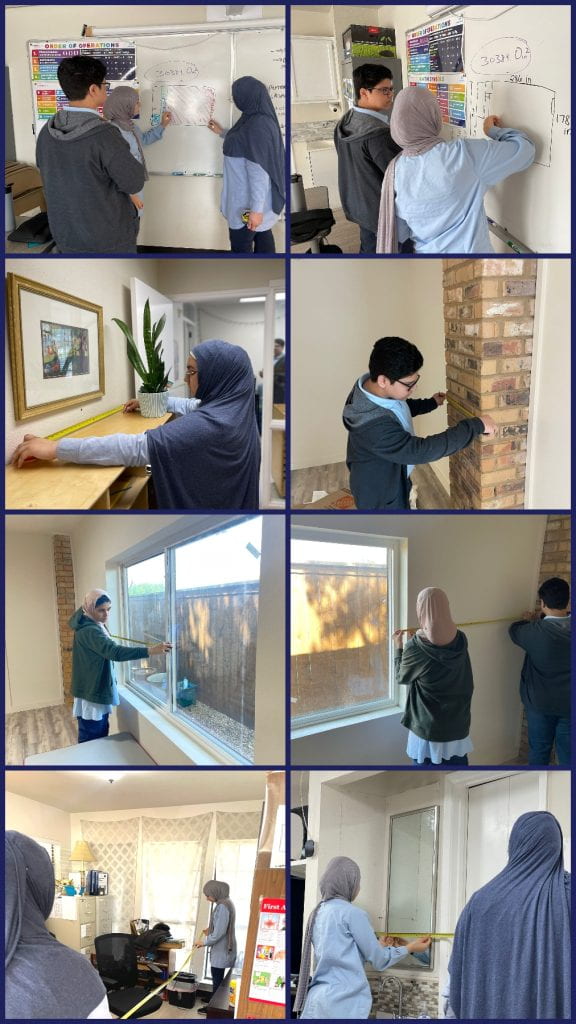
In 6th grade, we learned about the measures of variability and box plots which includes solving for interquartile range, mean absolute deviation, and the five data points on the graphical display of a box and whisker plot. The students reinforced their mathematics knowledge by doing thorough review and math drills over exponents, order of operations, LCM, GCF, fractions, decimals, ratios, integer operations, mean, and percent. Lastly, the 6th graders created a blueprint of Wisdom Academy by measuring and finding the area and perimeter of different rooms.

In 8th grade, we explored the applications of quadratic equations, perimeters and areas of composite plane figures, linear inequalities systems and graphing, map scale and calculations of area, dot plots, set notations, the meaning of probability and inverse proportions. Lastly, the 8th graders created a blueprint of Wisdom Academy by measuring and finding the area and perimeter of different rooms. 

Middle School students and their teachers enjoyed a cafe treat after spending the day filming a documentary video about the history of Downtown Carrollton, Texas.
6th Graders measuring the Primary Classroom in order to find its perimeter
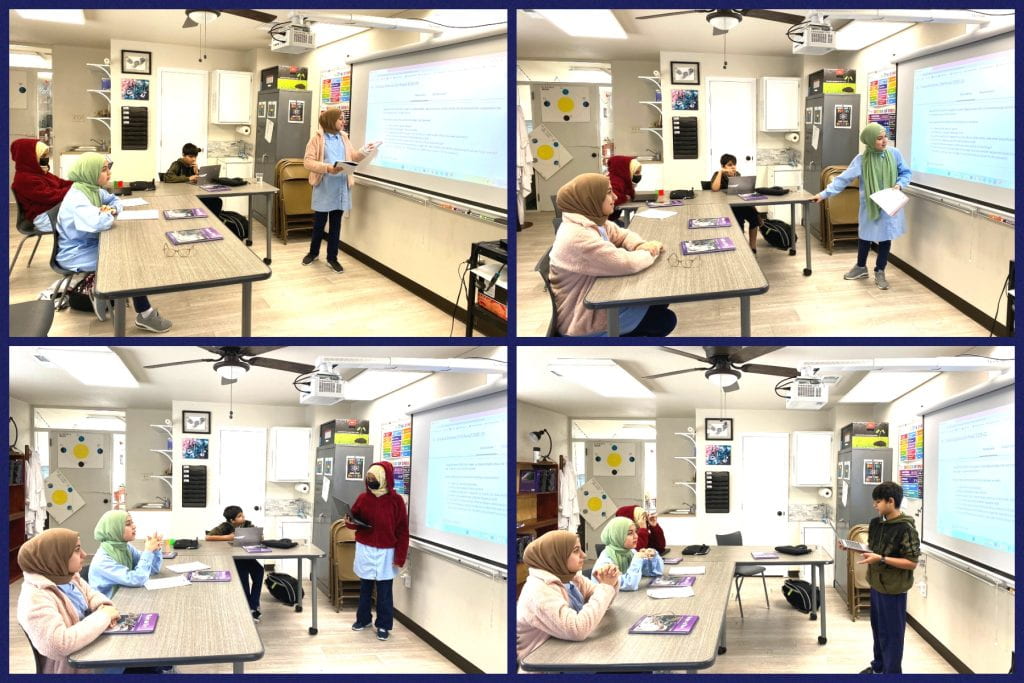
6th Graders were busy during May! Above photos include: drawing a blueprint of the school building from memory, reinforcing lessons with the Kahoot website, working together to find the area of composite figures, and working on their problem-solving speed.
8th Graders solving the area and perimeter of the Math and Science Classroom, measuring other classrooms, and working on drawing the blueprint of the Wisdom Academy building.

8th Graders at The History of Flight Museum

Congrats to the 8th Grade Graduates!

By Mrs. Malak Charara, Science Teacher

Grade 6 students wrapped up their energy transfer through matter investigations and where we can observe its effects in ocean currents and climate changes. Also, Grade 8 students concluded their investigations and studies of Newton’s laws and applied them collisions and concussions as examples from our everyday lives.

As we come to an end to this fruitful academic year Alhamdulillah, I would like to thank our students and you as parents for all the time and effort you’ve put towards success.

Grade 6 students taking care of their plants
Grade 8 students enjoying their field trip to the Flight Museum
Grade 8 students celebrating their graduation from Middle School

April 2023 Middle School News

By Br. Yusuf Ali, Mrs. Malak Charara, and Ms. Shames Alaesa

English/Social Studies/Electives News by Br. Yusuf Ali

In English, the 6th graders completed the novel Watership Down and continued developing their understanding of literary elements such as plot, character types, setting, and conflict. The 8th graders have continued reading the novel Around the World in Eighty Days by Jules Verne, which has served as an entertaining introduction to the political and physical geography of the late 18th century.

In 6th grade social studies, we concluded our study of Ancient Greece and are now studying Ancient Rome, including the periods of republic and empire. In 8th grade social studies, we completed a unit on the Civilations of the Americas and will be starting a unit on the Renaissance and Reformation periods in Europe.

In 6th and 8th grade electives, the students continued pursuing a variety of self-selected projects and topics to study such as the school yearbook, student candle and soap-making business, a student book club, and drama club.

Science News by Mrs. Malak Charara

April was filled with the blessings of Ramadan and so, Middle Schoolers took the time to review and be assessed on their science lessons as they do for their spiritual needs during this holy month. 

Grade 6 students used the foundation they built in the previous month and learned more about some properties of matter like density and ways to transfer energy in fluids via the process of convection through engaging lab experiments.  

Grade 8 students started exploring other forms of energy in their new investigation book “Gravity and Kinetic Energy,” identified variables affecting energy values, and discussed examples of energy transformation between different forms from our everyday lives.

Grade 6 Students worked on several experiments to understand the concepts of density and convection in fluids through layering of several prepared solutions.
Studying concepts of density and convection in fluids
Grade 8 students discussed their Electrical Cars research assignments with their peers. Mehdi decided to compare a model from each of these two companies: Tesla and BMW.

Math News by Ms. Shames Alaesa

In 6th grade, we learned how to display information in bar graphs, stacked bar graphs, and dot plots. The students learned how to solve and understand the purpose of measures of variability such as mode, median, mean, range, and interquartile range. Additionally, we have spent a number of days reviewing for our end of the year testing. 

In 8th grade, we explored the different methods in solving quadratic equations which include factoring, completing the square, quadratic formula, and graphing method. Additionally, we have spent a number of days reviewing for our end of the year testing. 

8th Grade Testing
6th Grade enjoyed watching the Prophet Yusuf series during lunch.
8th Grade learned how to apply the Quadratic Formula to find the height of a bridge.
8th Graders debating their Math conclusions with each other.
Reviewed for the End of the Year Exam.

Middle School 2023 Eid al Fitr Gift Exchange

CLICK BELOW FOR MORE APRIL 2023 NEWS


Primary 

Elementary 


Quran

March 2023 – Middle School News

SCIENCE NEWS: By Mrs. Malak Charara

March was a light month for science lessons since it included our Spring Break, yet Middle Schoolers were able to learn several new concepts.

Grade 6 students continued their investigations of “weather and water” and were introduced to one of the important parameters in the atmosphere which is Air Pressure–how it is measured and what factors affect its value. Students were also introduced to the Three States of Matter (solid, liquid, and gas) and some of its properties to help set the foundation for the upcoming lessons.

Grade 6 students working on several experiments to understand the concept of Air Pressure

Grade 8 students resumed their studies about electricity and made connections with what they learned about magnetism to explore the phenomenon of electromagnetism and how engineers used it to make our lives easier in many applications. They finished their “Electromagnetic Force” book, learning about the history of inventing the first automobiles and how it led to inventing electrical cars. We identified some of the challenges related to these cars and the possible solutions and compared different models on the market based on each’s features. Finally, students discussed various energy resources in terms of their effects on the environment and the future of Renewable Energy Resources.

Grade 8 Exploring the concepts of Electricity and Electromagnetism

The month also included a lovely day to plant flowers and seeds with the parents at our Planting Day Event.

ENGLISH / SOCIAL STUDIES / ELECTIVES NEWS: By Mr. Yusuf Ali

In English, the 6th graders have continued reading the novel Watership Down and developing their understanding of literary elements such as plot, character types, setting, and conflict. The 8th graders have begun reading the novel Around the World in Eighty Days by Jules Verne.

In 6th grade social studies, we concluded our study of Ancient China and are now studying Ancient Greece, including the city-states of Athens and Sparta, as well as the empire of Alexander the Great. In 8th grade social studies, we completed a unit of Medieval Japan and are now doing a short survey and review of U.S. History in order to prepare for the yearly standardized exam.

In 6th and 8th grade electives, the students continued pursuing a variety of self-selected projects and topics to study such as the school yearbook, student candle and soap-making business, a student book club and drama club.

Middle School also participated in the Mawlid al Hujjah event with presentations and by writing poetry.

MATH NEWS: By Ms. Shames Alaesa

Here is a snapshot of Middle School Math for March: The students started a Math experiment on how much Liquid Volume fast food cups hold with and without ice.

Students also enjoyed some games and watched the Prophet Yusuf film to kick off Spring Break.

CLICK HERE FOR MORE:

Quran

Elementary

Primary

February 2023 Middle School News

By Br. Yusuf Ali (English, Social Studies, Electives), Mrs. Malak Charara (Science),

and Ms. Shames Aleasa (Math)

By Mr. Yusuf Ali
Middle School English, Social Studies, Electives Teacher

In English, the 6th graders have continued reading the novel Watership Down and developing their understanding of literary elements such as plot, character types, setting, and conflict. The 8th graders completed the play Hamlet by William Shakespeare. As a final project, they chose to put on a performance of the first scene of the play. They memorized the lines, made props, and rehearsed for several days before inviting students and staff from Upper Elementary and 6th grade to watch their performance.

In 6th grade Social Studies, we are close to concluding our study of Ancient China, including the Qin and Han Dynasties. In 8th grade Social Studies, we are also studying Chinese civilization, but in the middle ages, including the Song, Tang and Ming Dynasties. We will soon start a unit on medieval Japan.

In 6th and 8th grade Electives, we had a guest speaker from the community who spoke to the students about mental wellness. The students also continued pursuing a variety of self-selected projects and topics to study such as the school yearbook, student candle and soap-making business, a shoe drive for school fundraising, a student book club, and a drama club.

By Ms. Shames Alaesa: 
Middle School Math Teacher

In Math, the 6th graders have dived into area of rectangles and parallelograms, area of triangles, area of trapezoids, volume of rectangular prisms, and surface area of prisms. 

In Math, the 8th graders have explored applications of pythagorean theorem, distance between two points, finding the slopes of straight lines, determining the equations of straight lines, and finding the surface area of a pyramid. 

By Ms. Malak Charara: 
Middle School Science Teacher

Grade 6 students wrapped up their Human Organ Systems investigation with the Nervous and Skeletal Systems. Afterwards, they started exploring a different branch of Science which focuses on weather and water topics.

Students were introduced to the most common severe weather examples and read about some of the natural disasters that have happened in the United States and around the world in the past. Students shared some events that happened recently in an assignment and discussed them with their peers. Despite the fact that humans cannot stop such disasters from happening, students learned about some ways to reduce their negative effects when applicable.

To understand the weather better, students started to investigate the components of the atmosphere, its different layers and their percentages. 

Grade 8 students continued their Physics investigations and were introduced to Newton’s three laws of motion; they learned how to calculate the net forces acting upon an object and whether those forces are visible or not. They moved on to exploring the concept of Magnetism as one of the invisible forces and learned how it helps us in our everyday lives. Later, we studied the concept behind lightbulbs, compared parallel and series circuits, and learned the difference between conductors and insulators.

Middle School students hopefully enjoyed their field trip to the ICR Museum where they were able to connect what they have learned so far in Science to visual, audio and kinesthetic representations and models. 

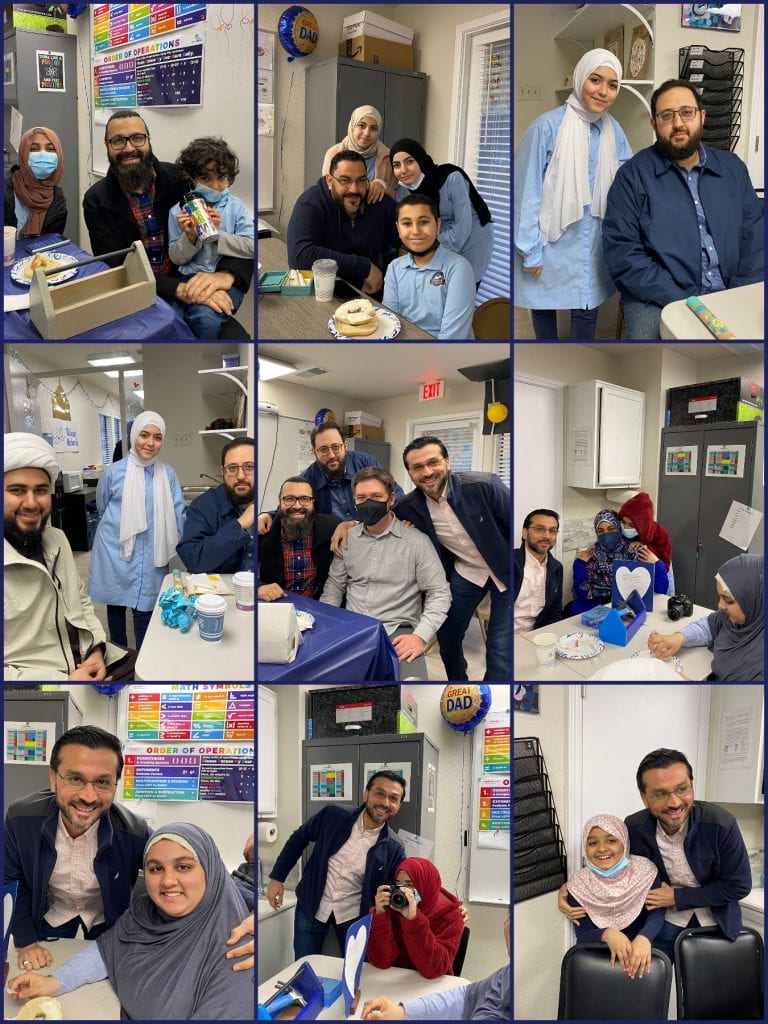
In addition, Middle School enjoyed the Father’s Day event–it was full of fun and love!

Father’s Day Event 2023

Middle School Science- Nov/Dec 2022 Updates

By Ms. Malak Charara:
Middle School Science Teacher

Grade 6 students continued their investigations to learn about the making of a new plant through pollination and fertilization and how seeds move from one place to the other. They moved on to explore some of the most important human organ systems which is what they’ll will be working on the upcoming weeks. They’re done with the Circulatory and Digestive systems.

Grade 8 students started investigating the relationship between Earth and its moon and the Sun it revolves around leading to events like day/night, seasons, and eclipses. They continued to learn more about other planets and objects in our planetary system.

Grade 6 students dissecting the Daily Lily flowers to learn about the male and female parts which are important for the making of a new plant.

Grade 6 Students started presenting their work on assigned organ systems.
(Top): Mariam presenting the Digestive System
(Bottom): Huda presenting the Excretory System
Grade 8 students demonstrating the phases of the moon with Oreos!
Grade 8 students
working on the lab activity “Lunar Craters Formation” to mimic craters found on the moon